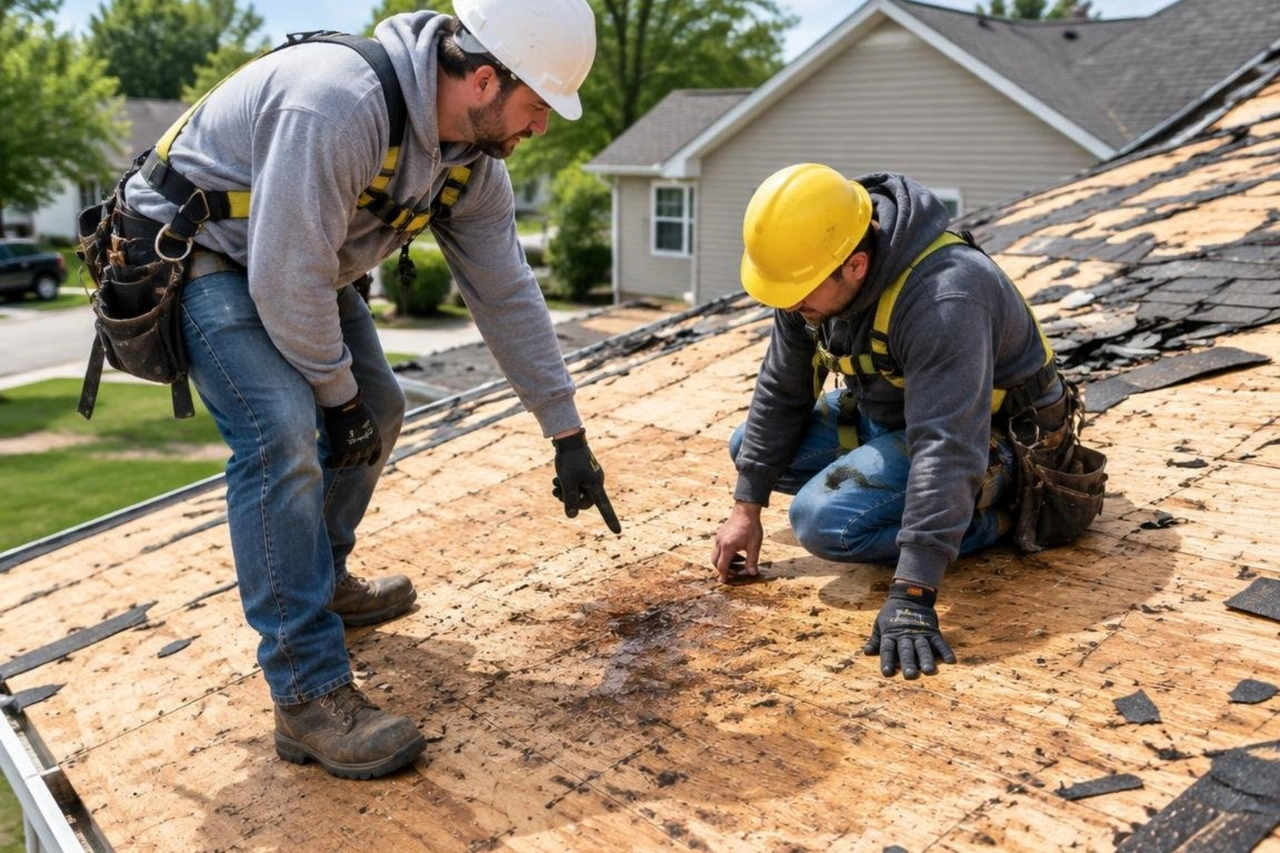
What Happens When a Roofing Crew Discovers Rotten Decking?
When a roofing crew strips away the old shingles and underlayment, the bare wood deck is exposed to daylight for the first time in decades. If the crew steps onto a soft spot or uncovers dark, crumbling wood, the job does not simply plow ahead.
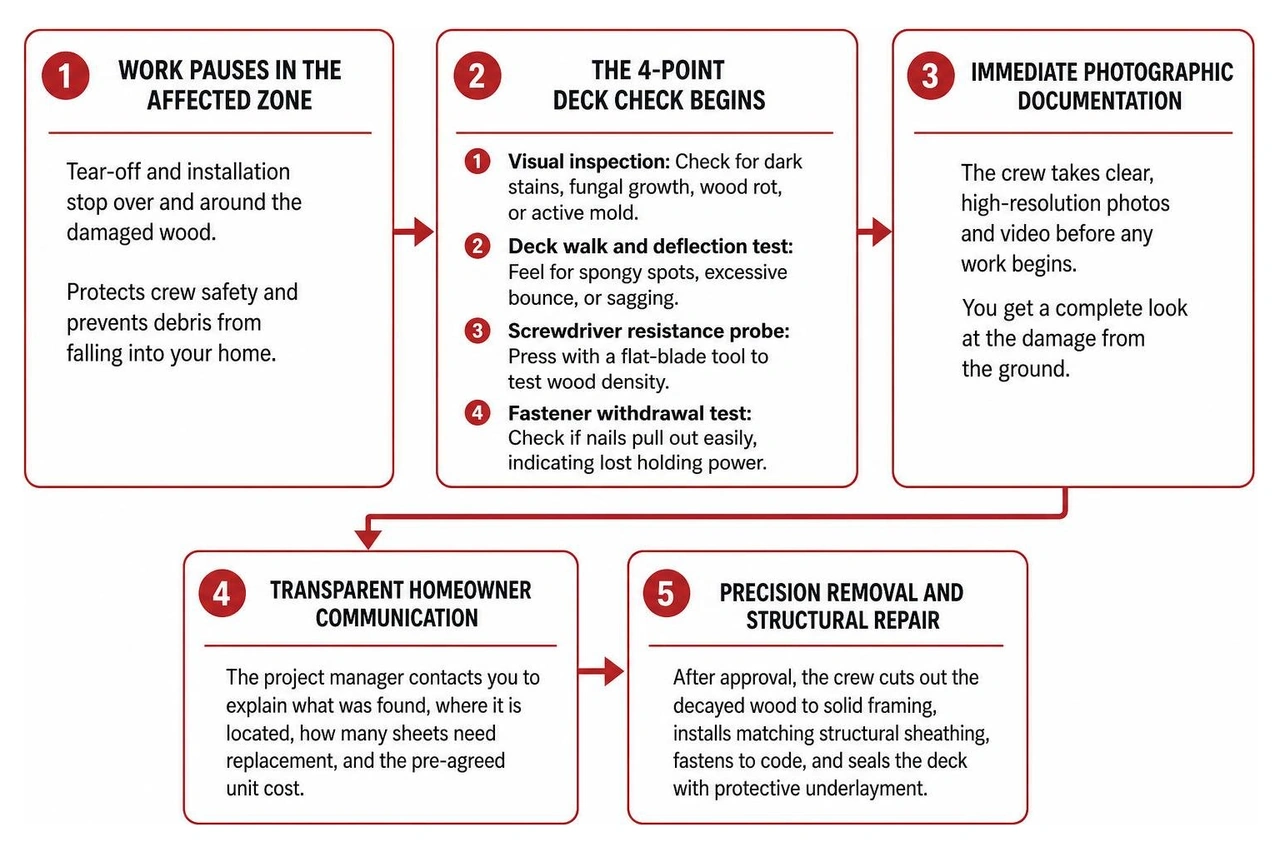
A reputable roofing crew follows a clear, professional protocol the moment rotted decking appears:
- Work Pauses in the Affected Zone: The crew immediately halts tear-off and installation activities directly over and around the damaged wood. Stepping on compromised sheathing is a severe safety hazard for the crew, and working over it risks dropping debris into your attic or living space.
- The 4-Point Deck Check Begins: To determine how far the decay extends, our crew performs an on-the-spot evaluation across four key criteria:
- Visual inspection: Checking for dark water stains, fungal growth, wood rot, or active mold.
- Deck walk and deflection test: Feeling for spongy spots, excessive bounce, or sagging between rafters.
- Screwdriver resistance probe: Applying firm manual pressure with a flat-blade tool to test the structural density of the wood fibers.
- Fastener withdrawal test: Checking whether existing nails pull cleanly out of the wood without resistance, which indicates lost holding power.
- Immediate Photographic Documentation: Before anything is cut or removed, the crew takes clear, high-resolution photos and video of the damaged panels. This visual proof gives you a complete look at the problem from the safety of the ground.
- Transparent Homeowner Communication: The project manager contacts you directly to explain what was found, where it is located on the roof, how many sheets of plywood or oriented strand board (OSB) need replacement, and what the pre-agreed unit cost will be.
- Precision Removal and Structural Repair: Once you approve the repair, the crew cuts out the decayed wood back to solid framing supports, installs matching structural sheathing, fastens it to building code standards, and seals the deck with protective underlayment.
Understanding what actually happens on the day my roof gets torn off helps remove the stress from this surprise. When a contractor has a clear protocol in place, finding damaged wood is not a project-stopping disaster. It is simply a necessary structural repair handled smoothly during the tear-off window.
Step-by-Step Deck Repair Process During Tear-Off
Fixing rotted roof decking is a precise carpentry task that must be done correctly to maintain the roof load capacity, especially under heavy Northwoods winter snow loads.
First, the crew marks the boundaries of the damaged area, extending several inches past the visible rot to ensure only completely sound wood remains. Decking panels cannot simply be cut off in mid-air. Every replacement sheet must bear directly on structural framing members. The crew sets circular saws to the exact depth of the existing sheathing to avoid scoring the rafters or trusses underneath, cutting cleanly along the centerlines of the supporting framing.
Next, the crew measures the existing sheathing thickness, typically 7/16-inch OSB or 1/2-inch to 5/8-inch CDX plywood. Matching the exact thickness is critical so the new wood sits completely flush with the surrounding roof plane, helping prevent uneven ridges in your new shingles.
The replacement panel is cut to size, leaving a standard 1/8-inch expansion gap at all panel edges to allow the wood to expand and contract naturally through changing temperature and humidity conditions. The new panel is then fastened using code-approved common nails or ring-shank nails spaced every 6 inches along supported edges and every 12 inches along intermediate rafters. Once secured, the crew immediately rolls out ice-and-water barrier or synthetic underlayment over the repair zone to protect the home against sudden weather changes.
Why Does Roof Decking Rot and Stay Hidden Until Tear-Off?
Homeowners are often surprised to learn that their roof decking has rotted when they never saw a single drip inside their living room. Roof decking sits sandwiched between the exterior weather barriers (shingles, synthetic felt, and ice-and-water membranes) and the interior attic insulation. Because of this layered design, moisture damage can develop and spread silently for years without penetrating your drywall ceiling.
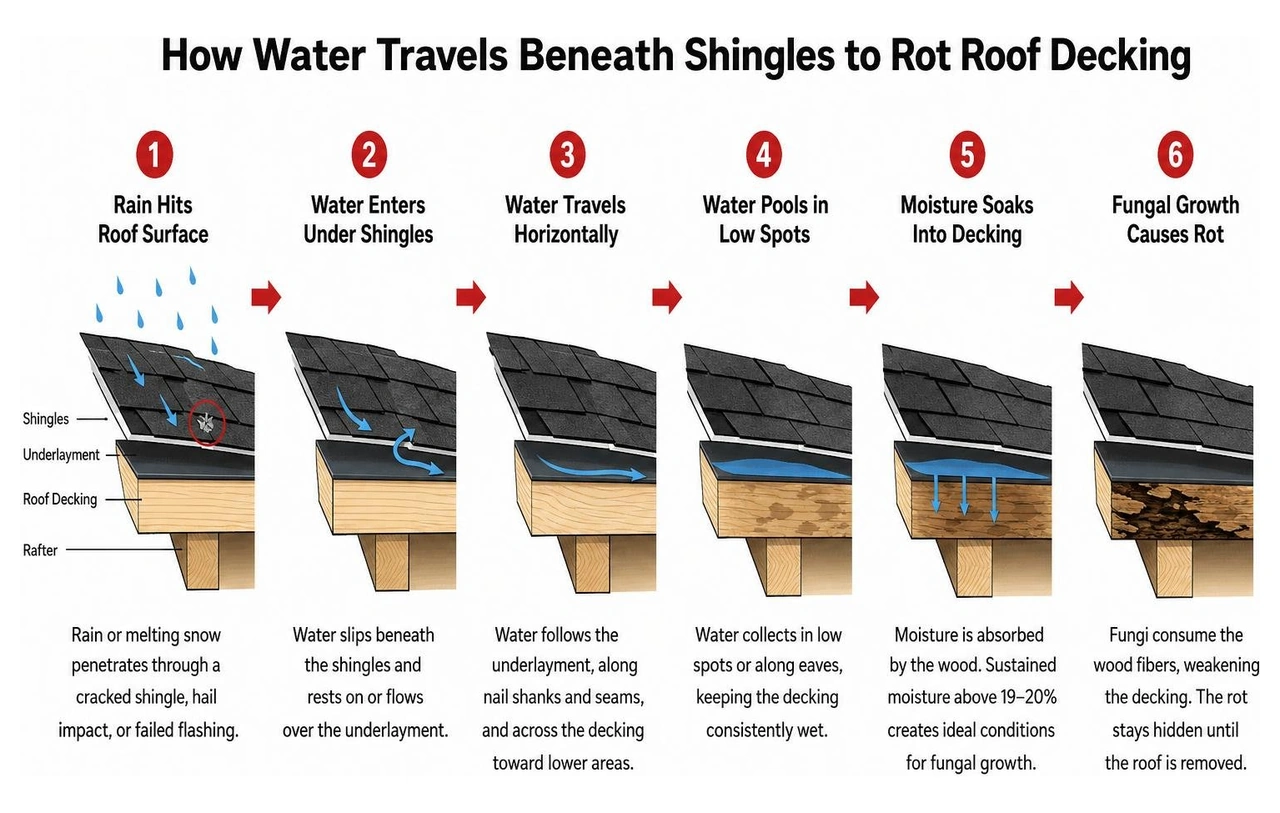
Water is opportunistic. When driving rain or melting snow bypasses a cracked shingle or failed chimney flashing, it rarely drips straight down into your living room. Instead, water tends to travel horizontally along nail shanks, underlayment seams, and roof rafters before pooling in low spots or along eaves. The wood decking absorbs this slow, recurring moisture like a sponge.
Over time, sustained wood moisture levels above 19 to 20 percent create an ideal environment for wood-decay fungi. Fungal rot actively consumes the cellulose and lignin that give wood its structural strength, turning rigid boards into soft, crumbly material.
In Northern Wisconsin communities like Eagle River, Minocqua, and Three Lakes, local weather cycles create unique moisture risks for roof decking:
- Winter Freeze-Thaw and Ice Damming: Heavy snow accumulation followed by warm attic air loss melts snow on upper roof sections. As meltwater runs down to cold eaves, it refreezes, forming ice dams. Water backs up beneath shingles and underlayment, soaking the eave decking year after year.
- Attic Condensation from Inadequate Ventilation: Warm, moist indoor air from cooking, showers, and heating rises into the attic. Without balanced ridge and soffit ventilation, this moisture condenses on the cold underside of the wood roof deck during sub-zero winter nights, rotting the sheathing from the inside out.
- Material Differences (OSB vs. Plywood): OSB and plywood react differently to long-term moisture exposure. Standard OSB tends to swell permanently at the edges when subjected to repeated water, losing its inner binder strength. Plywood tends to delaminate layer by layer, separating into thin, pliable sheets that lose their nail-holding capacity.
- Pine Needles and Valley Debris: In heavily wooded Northwoods lake properties, accumulating pine needles trap moisture in roof valleys and against dormer walls, accelerating localized wood decay beneath flashing transitions.
Homeowners can often spot early warning signs from the ground or inside the attic by following a seasonal roof inspection checklist before a tear-off takes place.
The Screwdriver Test for Sound Wood
Roofers often encounter dark or stained wood that looks concerning at first glance. However, dark wood does not automatically mean the decking is rotted. Old water staining or cosmetic surface discoloration can occur without destroying the structural strength of the panel, as noted in guidelines on roof decking structural evaluation and rot signs.
To distinguish harmless surface stains from active fungal rot, roofers use the standard screwdriver test. Using firm manual pressure, a technician presses the flat tip of a screwdriver directly into the suspect wood:
- Sound, Structurally Fit Wood: Resists penetration firmly. The screwdriver tip will not sink deeper than roughly 1/16 of an inch into the wood fiber. If the wood remains solid and rigid, it can securely hold roofing fasteners and does not require replacement.
- Compromised, Rotted Wood: Allows the blade to sink deeply and easily into the board with little effort, producing a spongy, fibrous, or crumbly texture. When wood yields to light or moderate hand pressure, its structural integrity is gone, and the sheet must be replaced.
How Much Does It Cost to Replace Damaged Roof Decking?
The cost of replacing damaged roof decking during a reroof project depends on the type of material, current wood commodity prices, roof accessibility, and the number of sheets that must be swapped out.
On average, replacing damaged roof sheathing during an active tear-off runs between $70 and $150 per 4x8 sheet installed (which equals 32 square feet of coverage). This translates to an installed cost of roughly $5 to $12 per square foot for localized wood repairs, factoring in material removal, new wood sheathing, code-compliant fasteners, and labor.
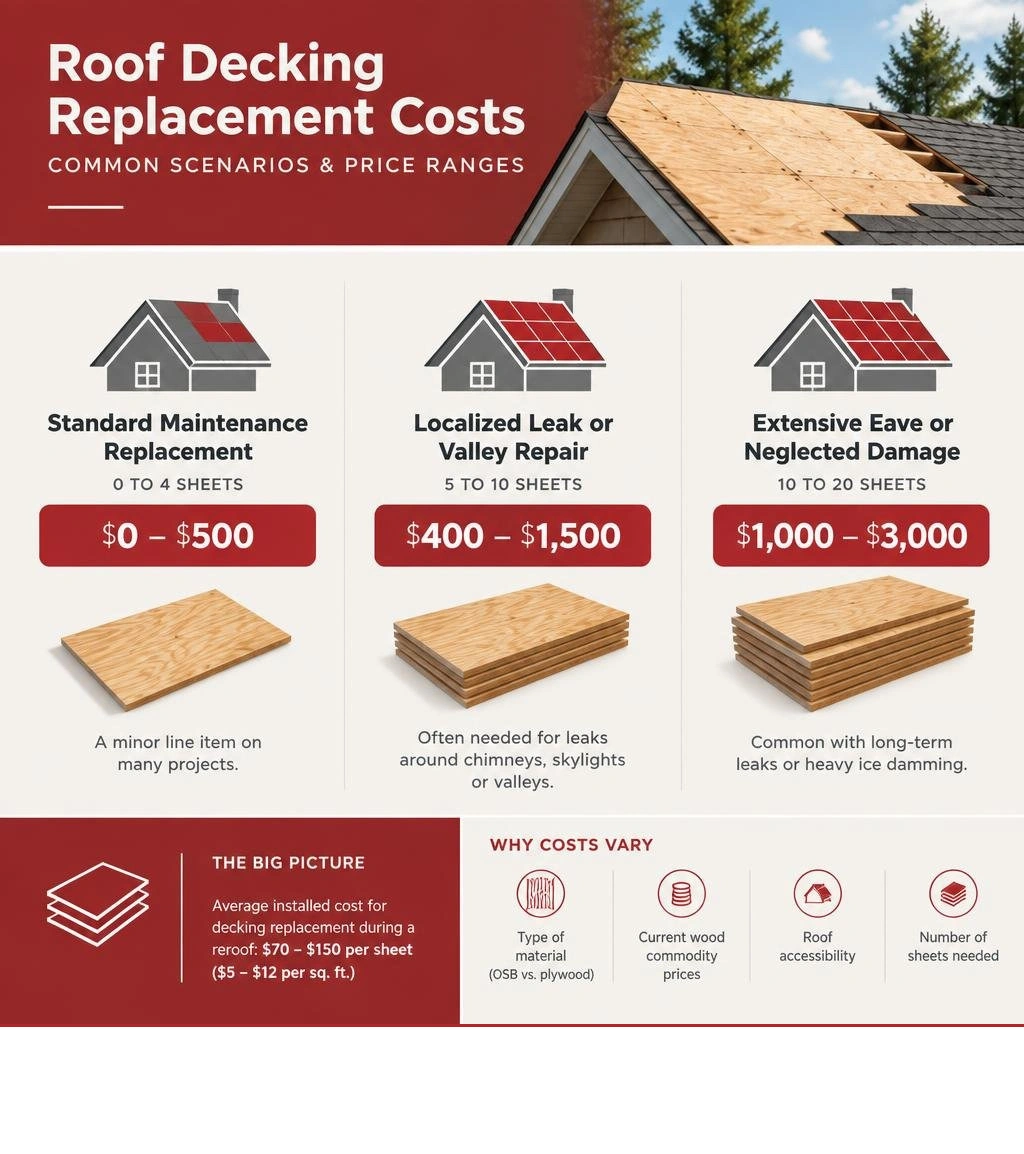
Here is how common decking repair scenarios typically break down on a residential project:
- Standard Maintenance Replacement (0 to 4 Sheets): On a reasonably maintained roof without major historical leaks, uncovering zero to four damaged sheets is standard. This represents a minor line item of $0 to $500, which many experienced contractors account for in their initial planning.
- Localized Leak or Valley Repair (5 to 10 Sheets): If a roof had a persistent leak around a chimney, skylight, or dead valley, the damage often spreads across multiple adjacent panels. Replacing a localized section generally costs between $400 and $1,500.
- Extensive Eave or Neglected Damage (10 to 20 Sheets): When chronic ice damming has affected the lower roof perimeter or a long-neglected leak was left unaddressed, replacing 10 to 20 sheets can add $1,000 to $3,000 to the final project invoice.
- Full Roof Redecking: If a roof suffers from catastrophic moisture failure, widespread structural sagging, or old spaced-board decking that fails local code for shingle fastening, a full deck replacement may be necessary. On a typical 2,400-square-foot roof, full redecking can range from $12,000 to $28,800, depending on sheathing grade, rafter repairs, and disposal fees.
| Repair Scope | Typical Sheet Count (4x8 Panels) | Estimated Cost Range | Common Causes |
|---|---|---|---|
| Minor Spot Repair | 1 to 4 Sheets | $70 to $500 | Minor pipe boot leak, minor condensation spot |
| Moderate Section Repair | 5 to 10 Sheets | $400 to $1,500 | Chimney flashing failure, valley debris buildup |
| Extensive Eave / Valley Rot | 10 to 20 Sheets | $1,000 to $3,000 | Chronic winter ice dams, unaddressed leak path |
| Full Roof Redecking | Complete Roof (75+ Sheets) | $12,000 to $28,800 | Delaminated plywood, non-compliant spaced boards |
To help avoid surprise billing at the end of the project, make sure you know what should be included in a roofing estimate. A transparent quote clearly states the estimated per-sheet replacement price for both OSB and CDX plywood before any work starts, which you can confirm during the estimate.
Factors Influencing Wood Replacement Pricing
Wood repair costs are shaped by several practical job conditions:
- Material Selection (Plywood vs. OSB): CDX plywood generally carries a higher material cost than standard 7/16-inch OSB sheathing. If your home currently has 5/8-inch plywood to support Northwoods snow loads, replacement panels must match that heavier specification.
- Roof Pitch and Accessibility: Working on steep-slope roofs (8/12 pitch and above) or multi-story structures requires specialized staging, safety harnesses, and extra handling, which increases the labor time required to carry and install heavy wood panels.
- Framing and Rafter Repairs: If water intrusion sat unchecked for decades, rot can occasionally spread from the sheathing into the top edge of a rafter or truss chord. "Sistering" a new framing member alongside a weakened rafter requires additional structural carpentry work beyond simple panel replacement.
- Local Building Code Requirements: Municipal building codes mandate specific panel thickness and nail-spacing patterns based on local snow load and wind zones. Complying with these standards ensures structural safety and passes municipal inspection.
Can New Shingles Ever Be Installed Over Damaged Wood?
The short answer is no. New shingles should never be installed over soft, spongy, or decayed wood decking.
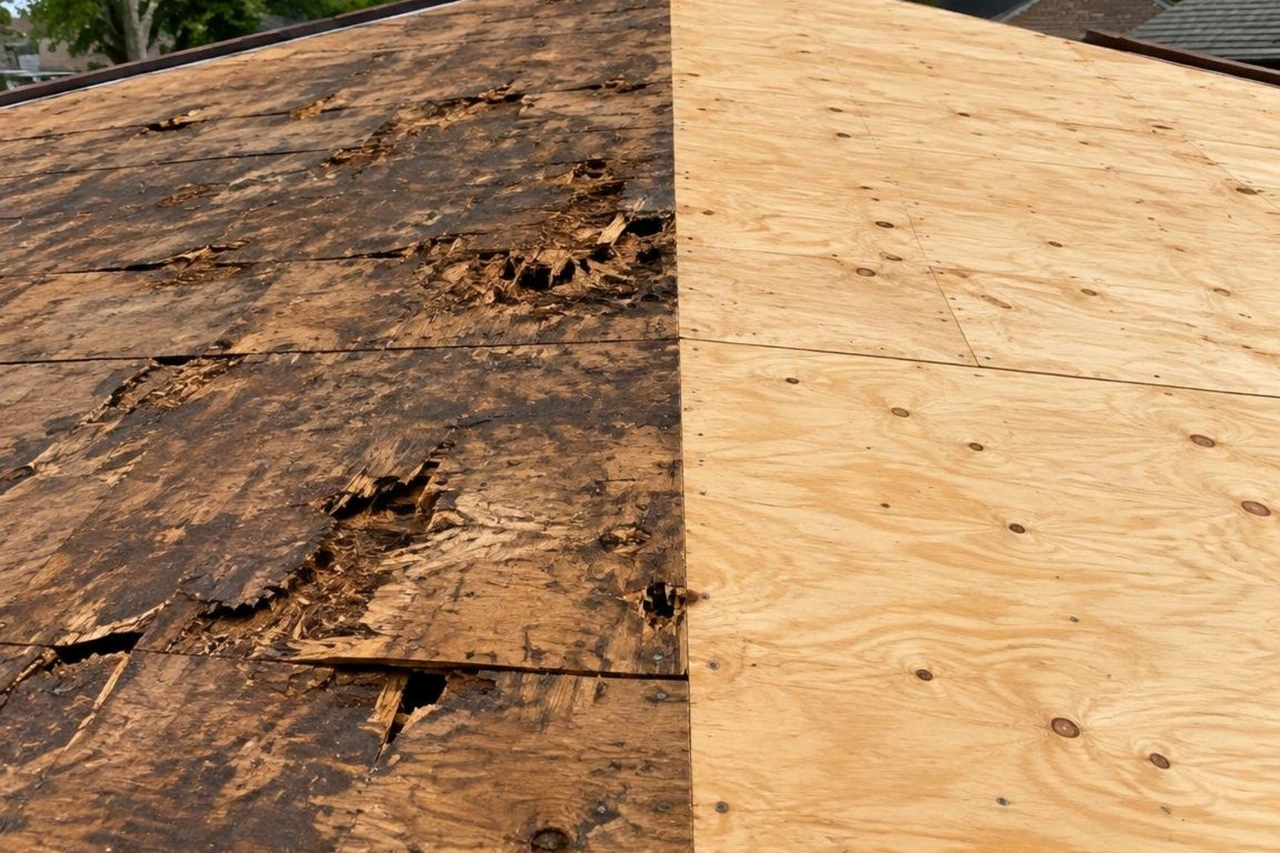
Installing shingles over rotted decking compromises the entire roofing system for several critical reasons:
- Code Non-Compliance: The International Residential Code (IRC Chapter 9) specifically mandates that asphalt shingles must be fastened to a solid, continuous, and structurally sound nailable deck. Nailing over decayed wood is a direct code violation.
- Fastener Pull-Out and Wind Blow-Offs: Roofing nails require dense, solid wood fibers to create mechanical friction. When a nail is driven into rotted sheathing, it sinks into soft pulp with zero holding resistance. During severe Northwoods lake winds or spring storms, shingles nailed into weak wood can blow off easily.
- Manufacturer Warranty Invalidation: Leading shingle manufacturers, including GAF, explicitly require a sound, stable decking substrate for warranty coverage. If shingles fail because fasteners pulled out of rotten wood, warranty claims for material defects will be denied, as detailed in our guide on what voids a roof warranty in Wisconsin.
- Asphalt Roofing Manufacturers Association (ARMA) Standards: ARMA guidelines require that any rotted, broken, or warped sheathing panels be replaced before laying down underlayment to maintain a uniform, planar roof surface.
The durability of an asphalt shingle roof depends on the strength of the wood deck beneath it. For residential asphalt roofs, Eagle River Roofing exclusively installs complete GAF roofing systems over structurally verified decking to support manufacturer warranty registration, depending on the product and registration requirements.
While some contractors work with other shingle brands like CertainTeed, we only install GAF roofing systems for residential replacements because their integrated components work together reliably when fastened to a sound deck.
How Can Homeowners Protect Themselves Before the Project Begins?
An ideal time to manage the risk of hidden deck rot is before the first ladder goes up against your gutters. With the right contract terms and contractor selection, you can avoid unexpected change orders and surprise fees.
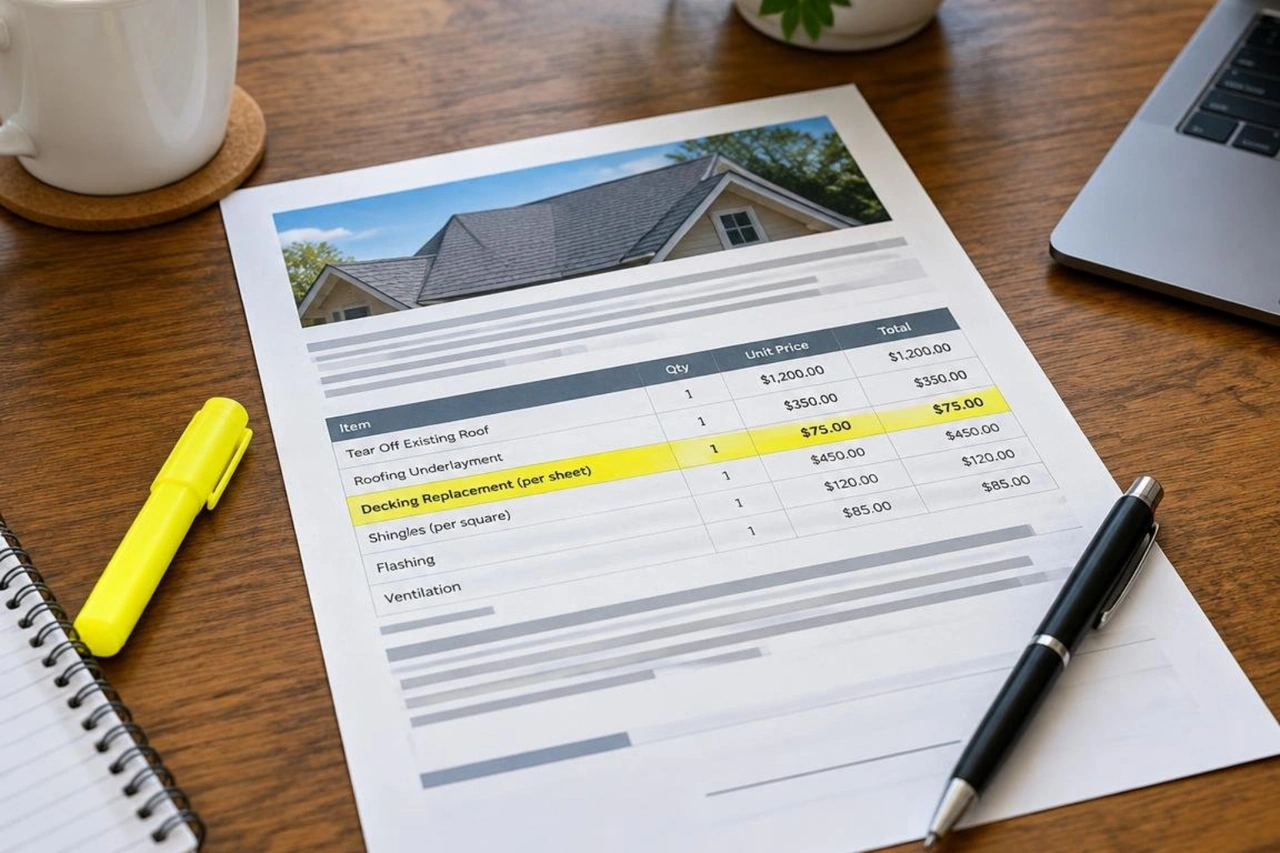
Here are the key steps every homeowner should take before signing a reroof contract:
- Demand a Clear Per-Sheet Unit Price in Writing: Never sign a contract with open-ended language like "decking repairs billed as time and materials." Your estimate should clearly state a fixed cost per 4x8 sheet for OSB and plywood, covering materials, labor, and fastener hardware.
- Require Photographic Proof Before Approval: Make sure your contract specifies that the contractor must photograph all damaged wood in place and explain the total sheet count before proceeding with extra billing.
- Establish an Authorization Threshold: Agree on an upfront protocol. For example, you can authorize the crew to automatically replace up to two damaged sheets to keep the project moving, while requiring written or verbal approval for any repairs beyond that count.
- Invest in a Pre-Reroof Attic Inspection: A professional attic evaluation (often costing between $150 and $400, or included during a comprehensive quote) allows an inspector to check the underside of the roof sheathing with a flashlight and moisture probe, flagging potential problem areas around chimneys, skylights, and valleys before tear-off starts.
- Choose an Experienced, Locally Owned Contractor: Work with an established local contractor who maintains tidy job sites, uses magnetic sweepers to catch loose nails, and has a proven track record. Eagle River Roofing, founded in late 2023 and built on a 50+ year legacy of local experience with over 9,000 roofs and 8 million feet of gutters installed, manages decking discoveries transparently with clear written quotes.
- Work with a Certified GAF Master Elite Contractor: Factory-certified contractors are held to stringent installation standards, ensuring that attic ventilation, underlayment barriers, and structural decking meet strict quality specifications.
To get a clear, detailed breakdown for your home without high-pressure sales tactics, request a free roof estimate that outlines all decking provisions in writing.
Frequently Asked Questions About Roof Deck Rot
How much extra time does replacing rotted decking add to the project timeline?
On most residential roofs, replacing a few sheets of rotted sheathing adds only 1 to 3 hours to the project timeline.
Experienced roofing crews carry extra sheets of 7/16-inch OSB and 1/2-inch or 5/8-inch CDX plywood directly on their service trailers. Because the tools and materials are already on-site, a skilled two-person carpentry crew can cut out damaged sections, install fresh wood, and dry-in the area with synthetic underlayment in less than an hour.
On qualifying projects, common repairs do not cause multi-day delays, allowing the full shingle installation to finish on schedule.
Will homeowners insurance cover rotted roof decking replacement?
Homeowners insurance coverage for rotted decking depends on the original cause of the damage:
- Sudden, Covered Perils (Often Covered): If decking was damaged by an acute storm event, such as a fallen tree branch, severe hail, or wind tearing away shingles during a major storm that allowed immediate rainwater entry, insurance will often cover the sheathing repair as part of the storm claim.
- Gradual Wear, Neglect, or Condensation (Typically Excluded): Standard homeowner policies exclude damage caused by slow, long-term leaks, deferred maintenance, or chronic attic condensation.
Clear photographic documentation taken by your contractor during the tear-off can help support legitimate insurance supplements if hidden storm-related damage is uncovered under old underlayment.
Can you tell if decking is rotted before tearing the roof off?
While some hidden wood rot cannot be seen until the old shingles are completely stripped away, an experienced inspector can spot several strong indicators beforehand:
- Spongy Bounce Underfoot: Walking the roof plane and feeling a distinct trampoline effect or soft deflection between rafters.
- Visible Sagging Between Rafters: Looking at the roof plane in low, angled sunlight to spot wavy dips or depressions where water might collect.
- Attic Inspection Clues: Inspecting the attic space for dark water streaks, white efflorescence, daylight leaking through nail holes, or localized mold along framing joints.
- Chronic Ice Dam Areas: A history of thick ice buildup along lower eaves often signals saturated wood sheathing underneath the drip edge.
What Is a Practical Next Step for Your Roof?
Discovering rotted decking when your roof is torn off can feel stressful, but it is actually an essential opportunity to protect your home. Replacing compromised wood helps ensure your new roof has a solid, continuous foundation that holds fasteners securely through heavy winter snow, fierce lake winds, and spring thaws.
When you work with a contractor who provides upfront per-sheet pricing, photo documentation, and skilled carpentry on-site, replacing damaged sheathing is a smooth, predictable process with zero surprises on your final invoice.
If your roof is showing signs of age, sagging, or chronic leaks, let our local Northwoods team give you an honest evaluation. You can start right now by getting an instant quote through the Eagle River Roofing instant estimate portal to take the first step toward a strong, weather-ready roof.
This article is for general informational purposes only and may not reflect the most current products, pricing, codes, availability, weather-related recommendations, or roofing requirements for your specific property. Every home and roof is different, especially in the Northwoods. Please contact Eagle River Roofing directly for the latest information and guidance for your project.

