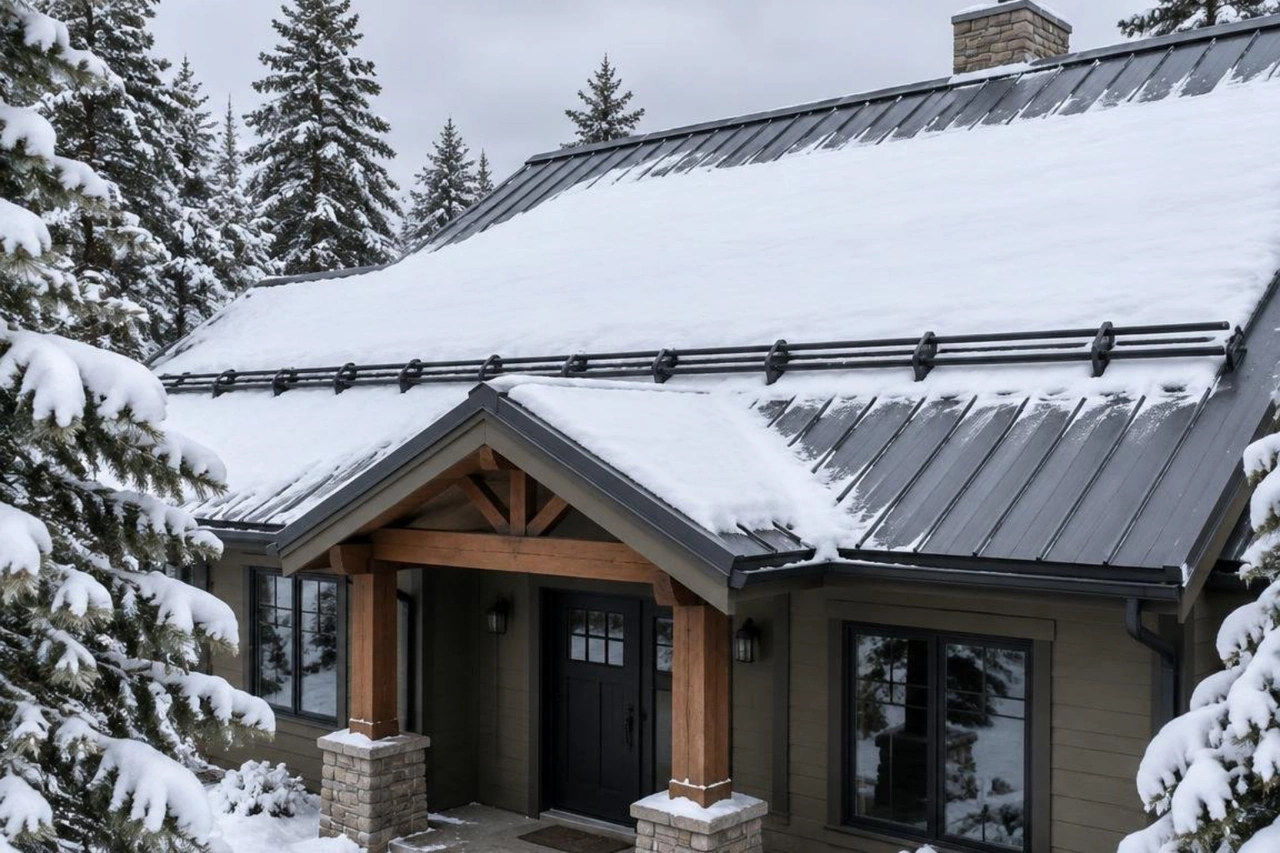
Why Do Metal Roofs in the Northwoods Release Dangerous Snow Avalanches?
Yes, in northern Wisconsin, metal roofs often need snow retention systems over entryways, walkways, and mechanical equipment to prevent dangerous snow avalanches caused by low-friction finishes. Metal roofs are widely chosen across the Northwoods for good reason: they are tough, handle heavy precipitation easily, and shed moisture quickly. However, that smooth surface also creates a specific winter challenge.
Painted metal panel finishes like PVDF (Kynar 500) and siliconized modified polyester (SMP) have a remarkably low friction coefficient, typically sitting between 0.10 and 0.15. By comparison, granular asphalt shingles maintain a rough surface with friction values between 0.30 and 0.40. Snow clings naturally to asphalt granules, but it sits loosely on a slick metal surface.
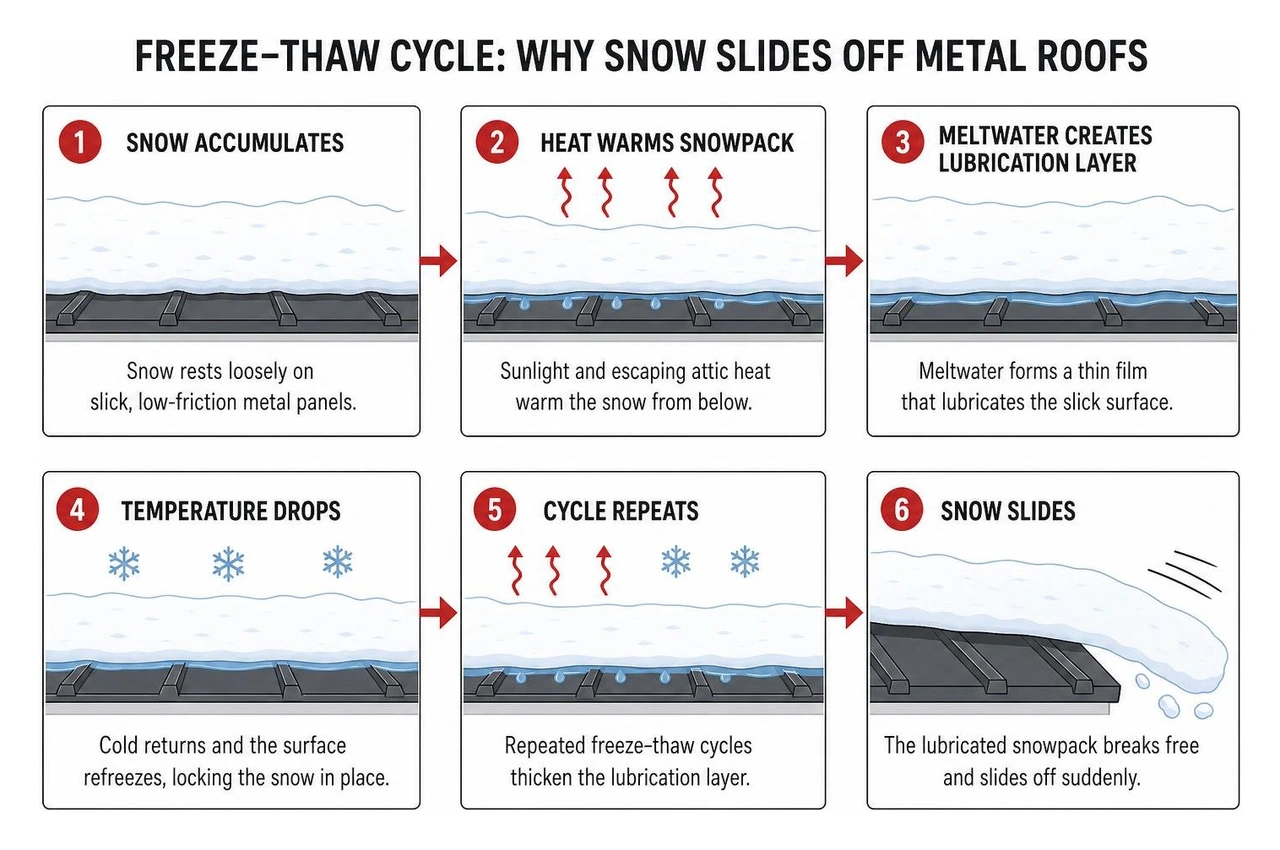
During winter in places like Minocqua and Three Lakes, two primary factors trigger sudden roof slides:
- Solar Gain: Even on sub-zero January afternoons, dark-colored metal panels absorb radiant heat from the sun. This warms the underside of the snowpack.
- Freeze-Thaw Cycles and Attic Heat: Warm indoor air escaping into the roof deck melts the lowest fraction of an inch of snow. That liquid water forms a microscopic lubrication layer across the smooth paint finish.
When this lubrication layer forms, friction drops nearly to zero. Without retention brackets in place, gravity takes over. The entire snowpack releases as a single cohesive slab, creating what roofers call a rooftop avalanche.
The weight involved is significant. A modest roof plane measuring 20 feet by 30 feet holding 12 inches of dense, settled Northwoods snow can easily weigh between 6,000 and 10,000 pounds. As that mass slides downslope, it generates thousands of pounds of kinetic vector force.
When that mass slides off an unprotected roof, the consequences are often immediate and severe:
- Crushed Gutters and Downspouts: Sliding ice slabs easily shear seamless gutters right off the fascia boards. Pairing snow rails with proper gutter sizing for steep roofs in snow country is critical to protect your drainage system.
- Structural Damage to Porches and Decks: Snow sliding from an upper metal roof onto a lower porch or deck on a durable metal cabin roof can crack framing and break railings.
- Equipment Damage: Falling ice commonly smashes ground-mounted heat pumps, outdoor air conditioning units, gas meters, and deck furniture.
- Crushed Landscaping and Dented Vehicles: Foundation shrubs are easily snapped, and cars parked near the eaves often suffer roof and hood dents.
- Severe Personal Injury: Heavy snow dropping from an 18-foot eave can cause devastating injuries to anyone standing or walking underneath.
Understanding how to control these forces through continuous metal roof snow rails and reducing roof avalanches is the foundation of winter roof safety in our northern climate.
Are Snow Retention Systems Mandated by Wisconsin Building Codes?
A common question we hear from homeowners in Eagle River, St. Germain, and Rhinelander is whether snow guards are legally required on residential metal roofs.
In Wisconsin, the Uniform Dwelling Code (UDC) governs one- and two-family residences, while the International Building Code (IBC) applies to commercial structures. Wisconsin building codes do not explicitly mandate snow guards on every single residential roof slope. However, Section 1608 of the IBC and related municipal codes do require building designs to mitigate hazards from falling snow and ice over public ways, entrance doors, emergency exits, and handicap ramps.
Even when local residential building inspectors do not specifically demand snow guards during a routine inspection, premises liability is a very real factor for property owners.
Under Wisconsin premises liability law, property owners have a legal duty of care to keep their property reasonably safe for invited guests, delivery drivers, contractors, and visitors. If a metal roof releases a snow slide that injures a delivery driver on a front walkway or damages a visitor's car in a driveway, the property owner can be held liable for resulting medical costs and damages.
For commercial properties, public venues, restaurants, and retail shops across the Northwoods, engineered snow retention plans are standard practice. For homeowners, installing snow guards is a sensible step to reduce liability risks while protecting costly exterior features.
You can review our Northern Wisconsin cabin roofing guide for more information on how local weather conditions shape Northwoods construction standards. For technical details on load calculations, review regional engineering guidance on snow guard spacing calculations and code guidelines.
Which Snow Guard System Is Right for Your Specific Metal Roof Profile?
Choosing the right snow retention system depends on your metal roof profile, roof pitch, rafter length, and local snowfall patterns. Metal roofs fall into two main categories: standing seam panels with raised vertical ribs, and exposed-fastener corrugated or ribbed panels.
| Snow Guard System Type | Ideal Metal Roof Profile | Retention Capacity | Panel Attachment Method | Typical Relative Cost |
|---|---|---|---|---|
| Continuous Pipe Snow Rails | Standing Seam Panels | High to Very High | Non-penetrating seam clamps | Moderate to High |
| Color-Matched Bar Fences | Standing Seam & Commercial | Very High | Heavy-duty non-penetrating clamps | High |
| Discontinuous Pad Cleats | Standing Seam or Exposed Rib | Low to Moderate | Seam clamps, screws, or adhesive | Low to Moderate |
| Fastened Bracket Stops | Exposed-Fastener Panels | Moderate to High | Mechanical screws into purlins/blocking | Moderate |
Clamp-On Continuous Snow Rail Systems for Standing Seam Panels
For standing seam metal roofs, continuous pipe or bar systems are widely considered the benchmark solution in northern Wisconsin.
These systems use precision-machined aluminum or stainless steel clamps that attach directly to the vertical standing seam. Here is why this design works so well for our climate:
- Zero Panel Penetrations: The clamps grip the seam using specially engineered round-point set screws. They do not puncture the metal, helping to preserve the factory paint finish and protecting the roof warranty, depending on the product and manufacturer requirements.
- Continuous Load Distribution: Instead of holding snow at isolated points, rigid aluminum or steel pipes run horizontally across the roof. This spreads the vector load evenly across multiple structural seams.
- Clean Appearance: Rail systems offer a clean, low-profile architectural appearance that complements modern standing seam metal profiles. Many systems allow the insertion of a color-matched metal strip directly from the roof coil.
We frequently install continuous pipe fences on standing seam metal roofs near Tomahawk, WI and throughout Lincoln, Oneida, and Vilas counties.
Discontinuous Pad-Style Snow Cleats
Pad-style snow guards, sometimes called snow cleats or snow stops, are small, individual units made from clear polycarbonate, cast aluminum, or stamped stainless steel. They are installed across the roof panels in spaced, staggered patterns.
Pad-style guards work by dividing the snowpack into smaller, less hazardous sections and allowing the snow to bridge between individual stops.
While pad guards are a budget-friendly option for moderate snow zones, they have distinct limitations in heavy Northwoods winters:
- A single row of pads near the eave is rarely strong enough to hold heavy northern Wisconsin snowpack.
- Under heavy snow loads exceeding 50 psf, individual cleats can bend or snap if they are not engineered in multiple, closely spaced rows.
- Polycarbonate pads can eventually become brittle from prolonged UV exposure and deep freeze cycles.
If pad cleats are used in northern Wisconsin, they should be laid out in a multi-row staggered grid based on an engineered spacing chart rather than an informal guess.
Exposed-Fastener Metal Panel Retention Systems
If your home, garage, or pole building has exposed-fastener ribbed panels (such as 5V crimp, Tuff-Rib, or classic R-panel), clamp-on seam brackets cannot be used because there is no standing seam to clamp onto.
For these roofs, snow brackets must be mechanically fastened directly through the panel flat:
- Structural Fastening: Fasteners must penetrate the metal panel and bite firmly into the underlying solid wood decking, roof purlins, or structural framing blocks. Fastening only into thin sheet metal will cause the screws to tear out under heavy snow loads.
- EPDM Weather Sealing: Every screw penetration must be sealed with heavy-duty EPDM rubber washer gaskets and high-grade exterior sealant to prevent water infiltration.
- Why Glue-On Guards Fail in the Northwoods: We strongly caution against adhesive-only glue-on snow stops in northern Wisconsin. The extreme freeze-thaw cycles and sub-zero temperatures typical of January and February can make chemical adhesives brittle, causing the pads to pop off during heavy spring slides.
For a deeper look at metal roof hardware and engineering, review manufacturer resources like the complete guide to snow retention and industry overviews on snow retention systems for metal panels.
Can Retaining Heavy Snow Cause Roof Overload or Severe Ice Dams?
Homeowners often worry about the added weight when considering snow guards: "If we hold all that snow on the roof instead of letting it slide off, could the roof collapse under the weight?"
The short answer is no, assuming the home was built to local building codes.
Understanding Structural Roof Loads
Homes and cabins in northern Wisconsin are engineered to carry significant ground snow loads, typically ranging from 45 to 60+ pounds per square foot depending on the exact county. Modern roof trusses and rafter systems are designed to support this static, balanced weight safely throughout the winter.
Snow guards do not add weight to your roof; they simply retain the snow that naturally falls there, distributing the load evenly across the roof plane. In fact, sudden uneven snow sliding can actually produce higher dynamic shock loads on trusses and fascia boards than a stable, evenly distributed blanket of snow.
The Real Cause of Ice Dams on Metal Roofs
Another common misconception is that snow guards create ice dams. Snow guards hold snowpack, but they do not cause ice dams.
Ice dams are caused by thermal dynamics and air leakage:
- Warm, conditioned air from the living space leaks into an under-insulated attic.
- The warm attic warms the upper roof deck above 32°F, melting the bottom of the snowpack.
- The meltwater runs down the roof under the snow until it reaches the cold, unheated eaves and overhangs.
- The water refreezes at the cold edge, building up a thick ridge of ice that traps subsequent meltwater behind it.
If your home suffers from chronic winter ice buildup, the real fix involves air-sealing attic bypasses, increasing insulation R-values, and ensuring balanced soffit and ridge ventilation. If you are experiencing cold-weather roof problems, read our guide on why ice dams form on the same roof spots every winter. You can also compare different roof profiles in our detailed look at reliable roof configurations for snow and ice dams in Wisconsin.
What Factors Determine Proper Snow Guard Placement, Spacing, and Cost?
Installing snow guards is not as simple as placing a few brackets right above the gutters. Successful snow retention depends on calculated layout engineering.
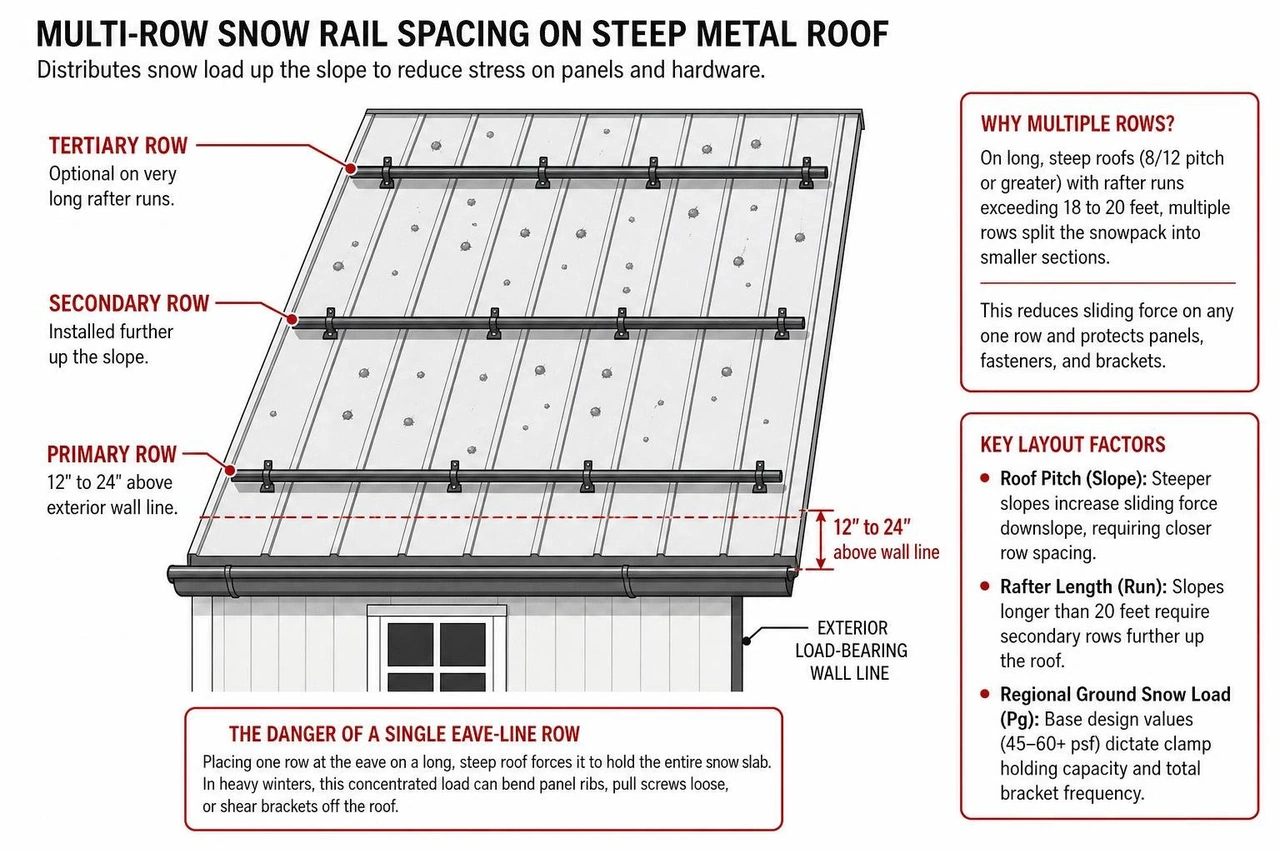
The Danger of a Single Eave-Line Row
A common installation error is placing a single row of snow guards right at the very edge of the eave on a long, steep roof.
When a large snow slab rests on a long rafter run (for example, 24 feet or more on an 8/12 pitch), a single row at the bottom must bear the entire sliding force of the whole roof plane. In a heavy winter, that concentrated shear load can bend panel ribs, pull screws loose, or shear brackets off the roof.
To prevent this issue, proper engineering distributes the load up the slope:
- Primary Row: Placed approximately 12 to 24 inches above the exterior load-bearing wall line. This positions the mechanical load directly above structural framing rather than out on an unsupported overhang.
- Secondary Rows: On rafter runs exceeding 18 to 20 feet, secondary and tertiary rows are installed further up the slope to split the snowpack into manageable sections.
Cost Considerations for Snow Retention in Northern Wisconsin
The overall investment to equip a metal roof with snow retention varies based on roof size, pitch, panel profile, and the style of hardware selected:
- Individual Pad Cleats: Typically represent a lower upfront material cost. However, because they require an engineered multi-row grid with extensive labor to provide adequate retention in snow country, overall project costs can approach those of simpler rail setups.
- Continuous Heavy-Duty Rail Systems: These engineered pipe and bar systems carry a moderate to higher upfront investment, but they provide substantial holding capacity and distribute snow loads across standing seams without penetrating the panels.
- Overall Project Scope: Total project costs depend on roof complexity, rafter lengths, and whether retention is needed solely above entryways or across entire eave lines. Your exact investment can be confirmed during a professional estimate.
When compared to the cost of replacing torn-off seamless gutters, repairing smashed heat pumps, or repainting dented vehicles, an engineered snow retention system is a practical, protective investment. To see how these systems fit into broader roofing budgets, review our comparison of metal roof costs versus asphalt shingles in Wisconsin.
You can also find useful context in professional guides on snow guards for metal roofs and spacing math and consumer overviews of preventing sleet and snow slides on metal roofs.
What Are the Most Common Questions About Metal Roof Snow Guards?
Will installing snow guards void my metal roof manufacturer warranty?
When installed correctly on standing seam panels using clamp-on systems, snow guards do not void your paint or weathertight warranties. Clamp systems use round-point set screws that compress against the metal seam without piercing or scratching through the protective Kynar or SMP coating.
However, drilling through standing seam panels with mechanical screws or using non-approved, sharp-tipped fasteners can void your manufacturer warranty. For exposed-fastener panels, using factory-approved screws with durable EPDM washers helps maintain weathertight performance.
Can snow guards be installed as a retrofit on an existing metal roof?
Yes. Clamp-on rail systems and mechanically fastened brackets can be retrofitted onto existing metal roofs at any time, provided the roof panels and underlying framing are in sound condition.
We recommend scheduling retrofit installations during dry weather in late summer or early fall. This allows our crews to complete the work safely and verify all set screws are torqued to manufacturer specifications (typically 130 to 150 inch-pounds) before winter weather arrives.
Is it sufficient to install snow guards only above entry doors and garage bays?
While installing isolated short rows above front doors, walkways, and garage doors is better than having no protection at all, "spot" installations carry specific risks.
Snow on a metal roof acts as a unified sheet. When snow is held in place above a doorway while the adjacent roof planes are open, the unsupported snow on either side can shift sideways. That lateral force creates uneven torsional strain that can twist brackets or shear isolated clamps. Wherever practical, we recommend protecting continuous eave lines across the full plane for balanced holding power.
How Can Eagle River Roofing Help Protect Your Northwoods Home This Winter?
Proper snow retention is an essential component of a durable, winter-ready metal roof in northern Wisconsin. Holding snow in place so it melts gradually protects your gutters, keeps walkways safe, and safeguards your home throughout our long winters.
At Eagle River Roofing, we understand how lake-effect snow, sub-zero cold snaps, and rapid spring thaws affect homes across Vilas, Oneida, Lincoln, and surrounding counties. We tailor every snow retention layout to the specific panel profile, pitch, and rafter run of your property. We are locally owned, founded in late 2023 on a 50+ year legacy of local experience, with over 9,000 roofs and 8 million feet of gutters installed. As a GAF Master Elite contractor, we bring tidy job sites and clear written quotes to every project.
If you are exploring a new roof installation or want to learn more about material options for our climate, read our complete guide to metal roofing.
Ready to protect your property before the next snowstorm? Get started today by requesting an Eagle River Roofing instant roofing estimate or check out our high-capacity Northwoods seamless gutter systems to make sure your home is prepared for whatever winter brings.
This article is for general informational purposes only and may not reflect the most current products, pricing, codes, availability, weather-related recommendations, or roofing requirements for your specific property. Every home and roof is different, especially in the Northwoods. Please contact Eagle River Roofing directly for the latest information and guidance for your project.

