
What Are the Top Financing Options for a New Roof?
When you decide to replace your roof without paying cash upfront, you can choose from several main funding options. Each option handles interest rates, repayment terms, and collateral differently.
Here is a quick look at the main ways to finance a roof replacement:
- Unsecured Personal Loans: Fast funding through banks, credit unions, or online lenders without putting a lien on your home.
- Home Equity Lines of Credit (HELOCs) and Home Equity Loans: Borrowing against your home's equity, which usually offers lower fixed or variable interest rates.
- Contractor Payment Plans: Point-of-sale financing arranged directly through your roofing company and their lending partners.
- 0% APR Credit Cards: Introductory credit card offers that let you pay off smaller repairs or replacement costs over 12 to 18 months without interest.
- Government-Backed Loans and Grants: Specialized loans or assistance programs from agencies like HUD or the USDA for qualifying homeowners.
To see how typical project pricing breaks down before you start shopping for loans, review our detailed guide on Average Roof Cost.
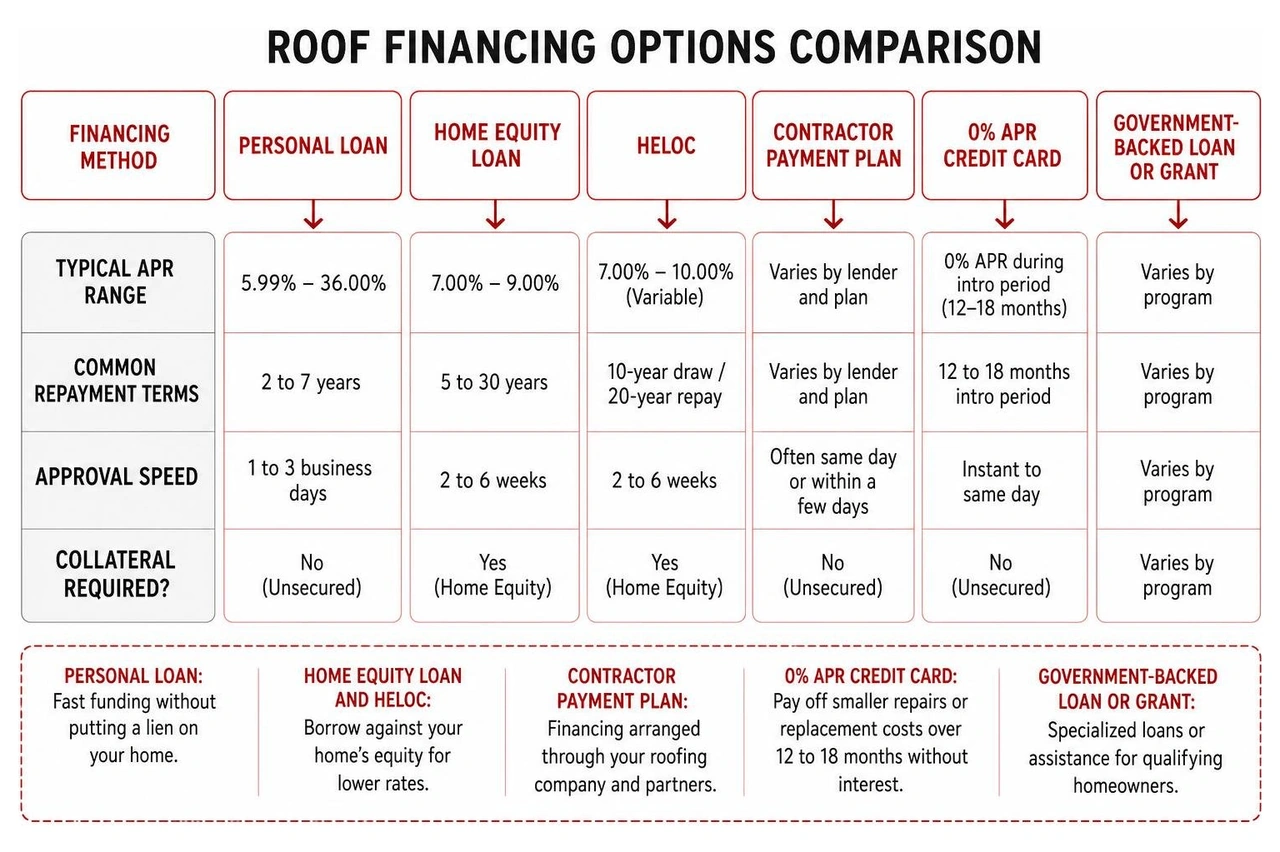
| Financing Method | Typical APR Range | Common Repayment Terms | Approval Speed | Collateral Required? |
|---|---|---|---|---|
| Personal Loan | 5.99% – 36.00% | 2 to 7 years | 1 to 3 business days | No (Unsecured) |
| Home Equity Loan | 7.00% – 9.00% | 5 to 30 years | 2 to 6 weeks | Yes (Home Equity) |
| HELOC | 7.00% – 10.00% (Variable) | 10-year draw / 20-year repay | 2 to 6 weeks | Yes (Home Equity) |
| Contractor Financing | 0.00% – 24.99% | 12 months to 10 years | Minutes to same day | Varies by lender |
| 0% APR Credit Card | 0.00% intro (then 21%+) | 12 to 18 months | Instant to 1 business day | No (Unsecured) |
| USDA Section 504 | 1.00% fixed | Up to 20 years | 3 to 8 weeks | Yes (for larger amounts) |
When you spread your project balance over a monthly budget, a $10,000 project at a 7.74% interest rate over 10 years equals about $120 per month. A $16,000 installation financed over 120 months equals roughly $200 per month. Matching your term length to your monthly cash flow keeps your home protected without stretching your savings too thin.
How Do Personal Loans Compare to Home Equity Financing?
Choosing between a personal loan and a home equity loan usually comes down to two things: how fast you need the cash and whether you want to use your home as collateral.
Unsecured personal loans do not require home equity, and lenders do not place a lien on your property. Approval times are very fast, often taking between 24 and 48 hours. This makes personal loans a solid choice if active roof leaks require immediate repairs. Interest rates typically range from 5.99% to 36.00%, depending on your credit profile. You can explore a thorough breakdown of loan structures in The Best New Roof Financing Options: 7 Loans to Consider .
Home equity loans and HELOCs use your property as collateral. Because the lender has security in your real estate, interest rates are usually lower, often falling between 7% and 10%. However, most banks require you to hold at least 15% to 20% equity in your home to qualify. Closing costs for home equity products typically run between 2% and 5% of the loan amount, and the appraisal process can take two to six weeks.
Under IRS Publication 936 guidelines, the interest you pay on a home equity loan or HELOC may be tax-deductible if you use the funds to make substantial improvements to your primary residence. We recommend speaking with a qualified tax professional to see if this applies to your tax filing.
How Do Contractor Financing and 0% APR Offers Really Work?
Many homeowners prefer contractor-arranged financing because you can complete the project scope and funding application during a single home visit. Contractors partner with financial institutions to offer direct payment plans with instant pre-qualification.
When looking at 0% APR promotional offers from contractors or credit cards, it helps to understand the difference between waived interest and deferred interest:
- Waived Interest: You pay zero interest during the promotional window (such as 12 or 18 months). If a balance remains after the promotion ends, interest only starts accruing on that remaining balance moving forward.
- Deferred Interest: If you carry even a $5 balance when the promotional period ends, the lender retroactively charges full interest on the entire original project total back to day one. For an $18,000 project, missing the payoff deadline by a single week could instantly trigger several thousand dollars in back-dated interest charges.
You should also watch out for hidden "dealer fees." Some contractors quiet increase their base project price by 3% to 15% on financed jobs to cover the fees lenders charge them behind the scenes.
At Eagle River Roofing, we believe in complete transparency. We provide clear, itemized quotes so you see the exact project cost upfront, and we help you explore flexible, straightforward Financing plans without hidden markups.
Can You Get Roof Financing with Bad Credit or No Upfront Money?
You can still finance a roof replacement even if your credit score is below 600 or you have limited credit history. While a score of 670 or higher opens up the lowest interest rates, several programs focus on factors other than standard credit scores.
If bad credit makes securing a private personal loan difficult, consider these paths:
- FHA Title I Property Improvement Loans: These government-backed loans help homeowners make necessary home repairs. Loans under $7,500 are typically unsecured, meaning you do not need home equity to apply.
- Adding a Co-Signer: Applying for a personal loan with a co-signer who has good credit can lower your interest rate and increase your approval odds.
- Subprime Lender Partnerships: Some home improvement financing partners specialize in helping homeowners with fair credit by reviewing your steady income and mortgage payment record rather than just your credit score.
You can compare low-credit loan limits and features further by reviewing Best Roof Financing Options in 2026 .
Most reputable lenders let you pre-qualify using a "soft credit pull." A soft pull checks your eligibility and shows you estimated monthly payments without affecting your credit score. Hard credit inquiries only happen when you formally accept the loan offer.
What Is PACE Financing and How Does It Work for Roofing?
Property Assessed Clean Energy (PACE) financing is a unique payment option designed for energy-efficient property upgrades. Unlike traditional bank loans, PACE financing does not require a minimum FICO credit score.
Instead of evaluating your personal credit history, PACE lenders review:
- The amount of built-up equity in your property
- Your history of on-time mortgage payments
- Your history of property tax payments
Under a PACE program, you can borrow up to 20% of your property's value for qualifying energy-efficient roofing materials with $0 cash down. You repay the financed amount through an assessment added directly to your annual property tax bill, which is often collected monthly through your standard mortgage escrow account. Terms can extend up to 30 years, and initial payments can sometimes be deferred for up to 18 months depending on installation timing.
Important Warning on PACE Financing: PACE creates a senior tax lien on your property that takes priority over your primary mortgage. Because of this lien structure, PACE financing can complicate your ability to sell or refinance your home down the road. Furthermore, residential PACE programs are geographically restricted and active primarily in California and Florida. It is not currently a common funding route for residential properties in Wisconsin or Michigan.
What Government Grants and Programs Help Pay for a New Roof?
If you have a tight household budget or live on a fixed income, federal and state government programs may help pay for a roof replacement or major repairs:
- USDA Section 504 Home Repair Program: Designed for low-income homeowners in rural areas. It offers 1% fixed-interest loans up to $40,000 with repayment terms up to 20 years. For homeowners aged 62 and older, grants up to $10,000 (or $15,000 in declared disaster areas) are available to fix health and safety hazards.
- HUD FHA 203(k) Renovation Loans: Allows home buyers or current owners to combine a roof replacement and primary mortgage into a single long-term loan based on the home's projected value after repairs.
- Weatherization Assistance Program (WAP): Administered by the U.S. Department of Energy, this program provides state-level grant funding to improve home energy efficiency and fix structural roof leaks for qualifying low-income households.
Qualifying criteria for government grants typically include:
- Proof that your home is located in an eligible rural or municipality zone
- Household income falling below specific local area median income limits
- Ownership and primary occupancy of the property
- Documentation showing the roof condition poses an active health or safety hazard
Will Financing a New Roof Impact Your Credit Score and How Fast Can You Get Approved?
How quickly your financing funds depends on the loan type you choose. Online personal loans and contractor financing plans can approve your application within minutes, releasing funds in one to three business days. Secured options like HELOCs, home equity loans, or government-backed grants involve property appraisals and title searches, which can take two to six weeks.
To keep your approval moving forward without delays, gather these key documents in advance:
- Recent pay stubs covering the last 30 days or W-2 forms from the past two years
- Government-issued photo identification (driver's license or passport)
- Recent mortgage statements showing your property balance and payment history
- A detailed, written roof estimate from a licensed roofing contractor
Pre-qualifying for a loan relies on a soft credit pull, which does not show up on your public credit report or lower your credit score. Once you formally apply, the lender performs a hard credit pull, which may temporarily drop your credit score by a few points.
Adding a new loan increases your total debt load, which affects your debt-to-income (DTI) ratio. Most lenders prefer to see a total DTI ratio below 43%, meaning your total monthly debt payments (including your mortgage and new roof loan) take up less than 43% of your gross monthly income. Paying off smaller credit balances before applying helps keep your DTI low and improves your loan terms.
How Can Homeowner's Insurance Help Cover Roof Replacement Costs?
Homeowner's insurance policies are designed to cover sudden, accidental damage caused by covered perils. If your roof fails due to severe hail, high winds, fallen tree branches, or fire, your insurance policy may cover a major portion of the replacement cost.
However, standard insurance policies exclude damage caused by normal wear and tear, age, or lack of routine maintenance. Asphalt shingle roofs over 20 years old often face closer review by insurance adjusters during claim assessments.
Understanding how your policy pays out is important:
- Replacement Cost Value (RCV): The insurance company pays the full cost to replace damaged materials with new equivalents, minus your policy deductible.
- Actual Cash Value (ACV): The insurance company deducts depreciation based on the age of your roof, paying out only what the old roof was worth at the time of damage.
If your policy pays ACV, you may face a gap between the insurance check and the total project estimate. You can bridge that out-of-pocket gap using a short-term personal loan, a contractor payment plan, or a 0% APR credit card.
When filing an insurance claim, make sure to follow these steps:
- Take clear photos and video of active leaks, damaged shingles, and indoor water stains right away.
- Schedule a professional inspection with a trusted local roofer to establish a clear scope of work before the adjuster arrives.
- Review our guide on What Should Be Included in a Roofing Estimate to confirm your quote contains proper material descriptions and labor costs.
- Submit your contractor's written assessment to your insurance adjuster to support a fair payout.
You can read additional expert recommendations on handling loan processing and insurance payouts in Roofing Financing: How to Finance a New Roof or Roof Replacement | SoFi .
How Do You Choose the Right Roofing Partner and Financing Plan?
Finding the right way to pay for a new roof works well when you pair smart financing with a dependable local contractor.
When comparing your financing choices, keep these practical rules in mind:
- For Urgent Repairs: Use an unsecured personal loan or a transparent contractor payment plan to get work started quickly and help protect against water damage.
- For Planned Replacements with Built-Up Equity: A home equity loan or HELOC provides lower interest rates if you have several weeks to complete the paperwork.
- For Short-Term Repayment: A 0% APR credit card or promotional contractor plan can save you money on interest, provided you pay off the full balance before the promotional window ends.
Working with an experienced local contractor helps protect both your home and your financial investment. Eagle River Roofing is locally owned, founded in late 2023, and built on a 50+ year legacy of local craft experience across northern Wisconsin and the Upper Peninsula. Our crews have installed over 9,000 roofs and more than 8 million feet of gutters across Eagle River, Rhinelander, Minocqua, St. Germain, Three Lakes, and nearby communities.
We know how harsh Northwoods winters can test a building. Heavy snow loads, severe ice dams, spring thaws, and high lake winds require heavy-duty installation details like synthetic underlayment, ice dam barriers, and balanced attic ventilation.
For residential shingle projects, we exclusively install GAF shingles. If you are comparing options like CertainTeed, we recommend GAF systems because of their proven durability in cold climates and their strong warranty options. As a certified GAF Master Elite contractor, we offer factory-backed warranty protection on qualifying projects, keep job sites tidy, and provide clear written estimates with no surprises.
To start planning your budget, take a look at our complete pricing guide, Cost of a New Roof Complete Guide, or request a custom Free Roof Estimate.
Frequently Asked Questions About Roof Financing?
What credit score is needed to qualify for roof financing?
A credit score of 670 or higher usually unlocks lower interest rates (typically 5% to 12%) on personal home improvement loans. However, options exist for scores in the upper 500s through government programs like FHA Title I loans, subprime home improvement lenders, or contractor payment plans that evaluate your steady income and mortgage payment history.
Can I finance just a minor roof repair instead of a full replacement?
Yes, you can finance minor roof repairs using unsecured personal loans, credit cards, or home improvement lines of credit. Some contractor-sponsored financing plans require a minimum project cost (often around $1,000) to qualify for promotional terms, so be sure to confirm payment thresholds during your estimate.
How do I avoid hidden dealer fees when financing through a contractor?
We recommend asking your contractor for both a written cash price and a financed price upfront. Reputable contractors maintain honest, flat-rate pricing regardless of how you choose to pay, helping ensure no extra lender dealer fees are hidden in your project total.
How Can You Get Started on Your Roof Replacement Today?
Financing a new roof without cash upfront lets you protect your home right away while keeping your emergency savings intact. By matching the right loan, equity product, or payment plan to your budget, you can address roof leaks promptly before minor issues turn into costly structural repairs.
Here is how you can take action today:
- Schedule a Professional Inspection: Identify whether your roof needs a targeted repair or a full replacement.
- Evaluate Your Financing Options: Compare personal loans, home equity options, and contractor payment plans based on your credit score, home equity, and timeline.
- Get a Clear Written Quote: Secure an itemized estimate that details labor, GAF roofing materials, disposal fees, and warranty details.
If you are ready to explore stress-free payment options for your home, visit our Contact Us page today. Our team at Eagle River Roofing will help you schedule a friendly, no-pressure inspection and find a payment plan that fits your monthly budget.
This article is for general informational purposes only and may not reflect the most current products, pricing, codes, availability, weather-related recommendations, or roofing requirements for your specific property. Every home and roof is different, especially in the Northwoods. Please contact Eagle River Roofing directly for the latest information and guidance for your project.

