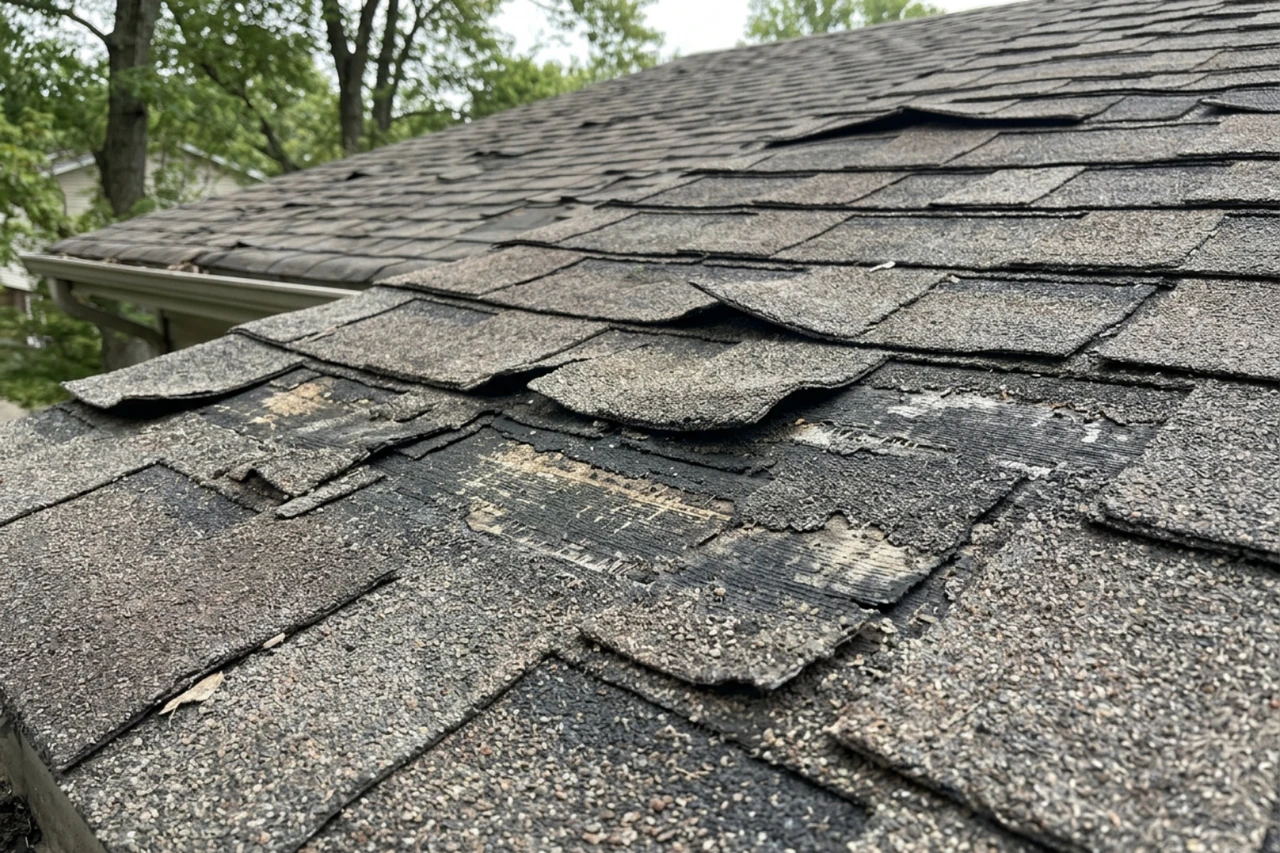
What Are the Visible Signs That Your Roof Needs Attention?
You do not need to climb onto your roof to spot the early warning signs of trouble. In fact, we usually recommend starting your inspection safely from the ground. Grab a pair of binoculars or use the zoom lens on your phone camera to scan your roof slopes from a few different angles in your yard.
When you are looking over your shingles, keep an eye out for these common visual indicators:
- Curled, Cupped, or Clawed Shingles: When shingle edges curl upward (cupping) or the middle sections start to buckle (clawing), the shingle is no longer lying flat to shed water. This shape distortion is often a sign of advanced aging or improper attic ventilation, which bakes the shingles from the underside.
- Cracked, Warped, or Missing Shingles: Strong lake winds can lift and tear shingles, leaving the dark underlayment or wood decking exposed to the elements. If you find shingle tabs lying in your yard after a storm, it is a clear sign your roof needs immediate attention to help prevent leaks.
- Granule Loss: Granules provide critical UV protection designed to help keep the underlying asphalt layer from drying out and cracking. While some granule shedding is normal on a brand-new roof, finding a tablespoon or more of sandy granules in your gutters or at the base of your downspouts indicates that your shingles are reaching the end of their functional lifespan.
- Moss, Mold, and Algae Growth: In our heavily wooded Northwoods areas, shaded roof sections often struggle to dry out. Moss acts like a sponge, holding moisture directly against the shingles and eventually lifting their edges, which allows water to seep underneath. Dark algae stains can also make a roof look older than it is, though algae is usually more of an aesthetic issue than a structural one.
- Damaged Flashing: Flashing is the thin metal installed around chimneys, dormers, valleys, and vent pipes to redirect water away from these vulnerable transition areas. If you notice rusted, loose, or cracked sealant around your flashing, water can easily bypass your shingles.
If you suspect your roof has suffered wind or hail damage after a severe seasonal storm, you can read more about navigating storm damaged roof repairs to understand your next steps. Catching these issues early can help prevent a small leak from turning into a major structural headache. For a complete list of what to look for, you can also refer to the 8 ways to know if you need a new roof guide published by the Institute for Business & Home Safety.
What should you look for inside your attic?
A thorough roof inspection typically includes a trip to the attic, especially during or immediately after a heavy rainstorm or a rapid spring thaw.
- Daylight Peeking Through: Turn off your attic lights and look up at the roof boards. If you can see pinpricks of daylight coming through the sheathing gaps, water can get in too.
- Active Leaks and Damp Insulation: Feel the insulation along the rafters and floor. Damp insulation loses its R-value and is a clear sign that water is bypassing your shingles and underlayment.
- Spreading Water Stains: Look for dark rings or water stains on the underside of the roof decking, along rafters, or on your interior ceilings and drywall.
- Mold, Mildew, or Musty Odors: If your attic smells musty or you see dark spots on the wood framing, moisture is getting trapped. This is often caused by a combination of minor roof leaks and poor attic ventilation.
To help you perform a thorough check of your home, we have put together a detailed roof inspection checklist that covers both interior and exterior trouble spots.
How Does the Age of Your Roof Influence the Decision?
The age of your roof is one of the most important factors in deciding between a repair and a replacement. Every roofing material has a design lifespan, and as a system nears the end of that window, repairs become less effective.
In our region, dramatic temperature swings cause materials to expand and contract rapidly. This thermal shock, combined with heavy snow loads and freeze-thaw cycles, bakes the protective oils out of asphalt shingles over time, making them brittle and prone to cracking.
If your roof is under 15 years old and has localized damage from a fallen branch or a minor windstorm, a targeted repair is often the right choice. However, if your roof is approaching or exceeding 80% of its expected lifespan, spending money on repairs can be a temporary band-aid. The shingles surrounding the repaired area may be too brittle to handle the physical repair process, often leading to a cycle of recurring leaks in new locations.
For more details on identifying when your roof is simply too old to save, check out our guide on roof replacement signs.
Expected lifespan by material type
Different roofing materials handle our harsh winters differently. Here is a quick breakdown of the expected lifespans and general characteristics of the systems we commonly install and service:
| Roofing Material | Expected Lifespan | Winter Durability & Characteristics |
|---|---|---|
| GAF Asphalt Shingles | 15 to 30 Years | Highly reliable; durable wind and algae resistance; requires proper ventilation to reach maximum lifespan. |
| Standing Seam Metal | 40 to 70 Years | Outstanding snow-shedding; hidden fasteners help prevent leaks; highly resistant to ice dams and heavy snow loads. |
| Flat Foam or Roll Systems | 15 to 30 Years | Common on commercial and low-slope residential structures; foam coatings can be recoated to extend life by 5 to 10 years on qualifying projects. |
What Is the 30% Rule and How Does the Cost Math Work?
When deciding whether to repair or replace, roofing professionals often use a few simple mathematical guidelines to help homeowners make an objective decision.
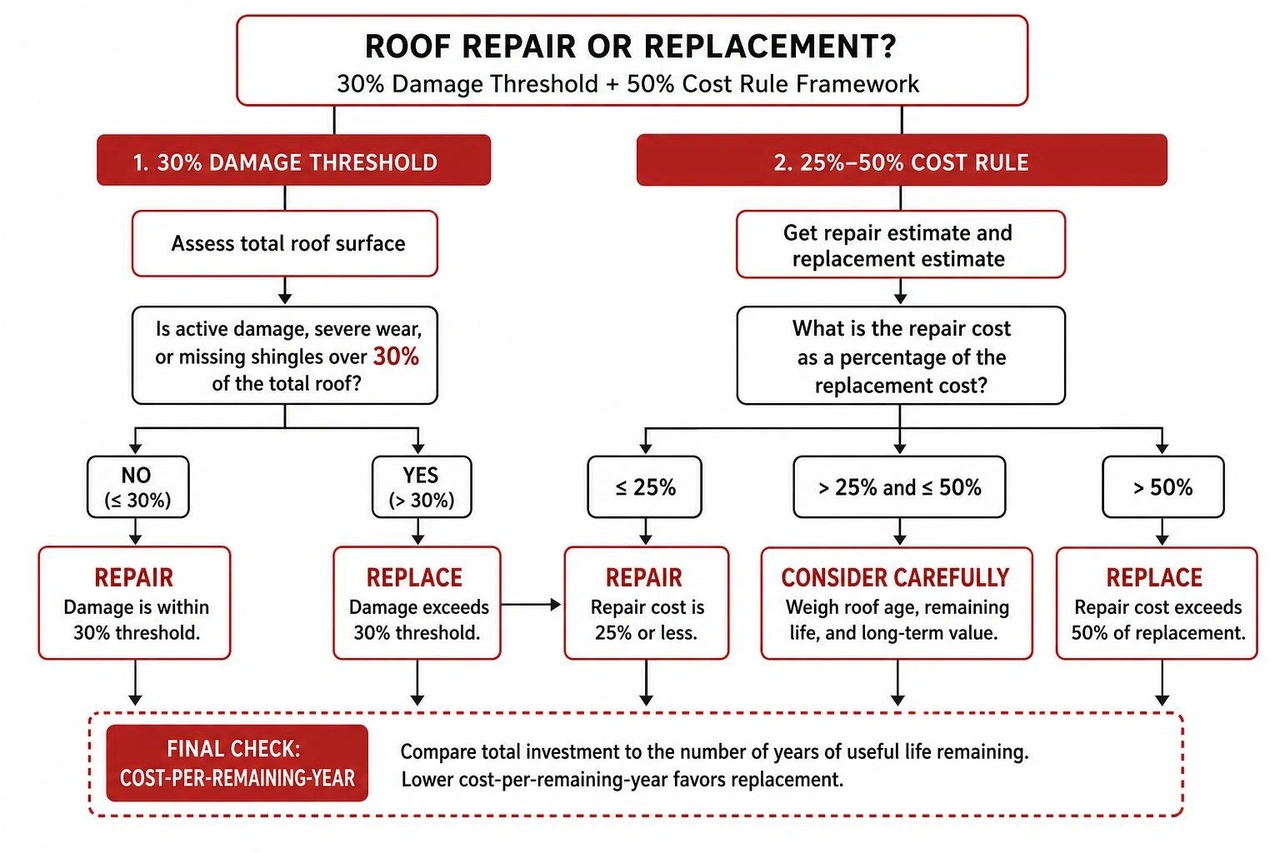
- The 30% Damage Rule: If active damage, severe wear, or missing shingles cover more than 30% of your total roof surface, a localized repair is rarely practical. At this point, the labor required to patch multiple scattered sections is often close to the cost of a full replacement, and you are still left with an old roof on the remaining 70% of your home.
- The 25% to 50% Cost Rules: If a reputable contractor gives you a repair estimate that exceeds 25% to 50% of the cost of a complete roof replacement, we usually recommend investing those dollars toward a new roof.
To make a practical financial choice, we suggest calculating the cost-per-remaining-year of your roof.
For example, if you have a 22-year-old asphalt roof that is near the end of its life, and you receive a quote to repair a leak around a chimney, that repair might only buy you another 18 months before another section fails.
On the other hand, if a new GAF asphalt shingle roof is designed to last 25 years with proper maintenance, your cost-per-year of service is often much lower. In this scenario, putting money into the old roof is actually more expensive in the long run than starting fresh.
If you have questions about budgeting or want to know what goes into a professional estimate, you can read our guide on roofing general and cost questions. You can also explore GAF's expert advice on understanding residential roof repairs how do i know if my roof needs to be replaced to see how manufacturers view the repair-versus-replace equation.
What are the hidden costs of delaying a replacement?
Stretching an old, failing roof a few more years can sometimes end up costing more than a timely replacement due to several hidden expenses:
- Interior Water Damage: A persistent, slow leak can rot attic rafters, ruin insulation, damage drywall ceilings, and lead to mold growth. Mold remediation and ceiling repairs can easily add thousands of dollars to your home maintenance costs.
- Energy Loss: When water saturates your attic insulation, the insulation loses its ability to trap heat. A compromised roof system with wet insulation or poor attic ventilation can increase your home heating and cooling costs by 10% to 25%.
- Insurance Risks: Many insurance carriers now inspect roofs via aerial photography or physical drive-bys. If your roof is past 20 years old or shows visible wear, your carrier may threaten non-renewal or transition your policy to Actual Cash Value (ACV), which pays out significantly less in the event of storm damage.
- Resale Value: If you plan to sell your home in the next few years, an old roof will almost certainly come up during the buyer's home inspection. A new roof typically recoups 60% to 70% of its cost at resale, helps your home sell faster, and can help prevent buyers from asking for steep price concessions.
When Do Hidden Structural Issues Require a Full Replacement?
Sometimes, the decision to replace is made for us by what is happening underneath the shingles. A roof is a complete system, and if the structural foundation is compromised, new shingles alone will not fix the problem.
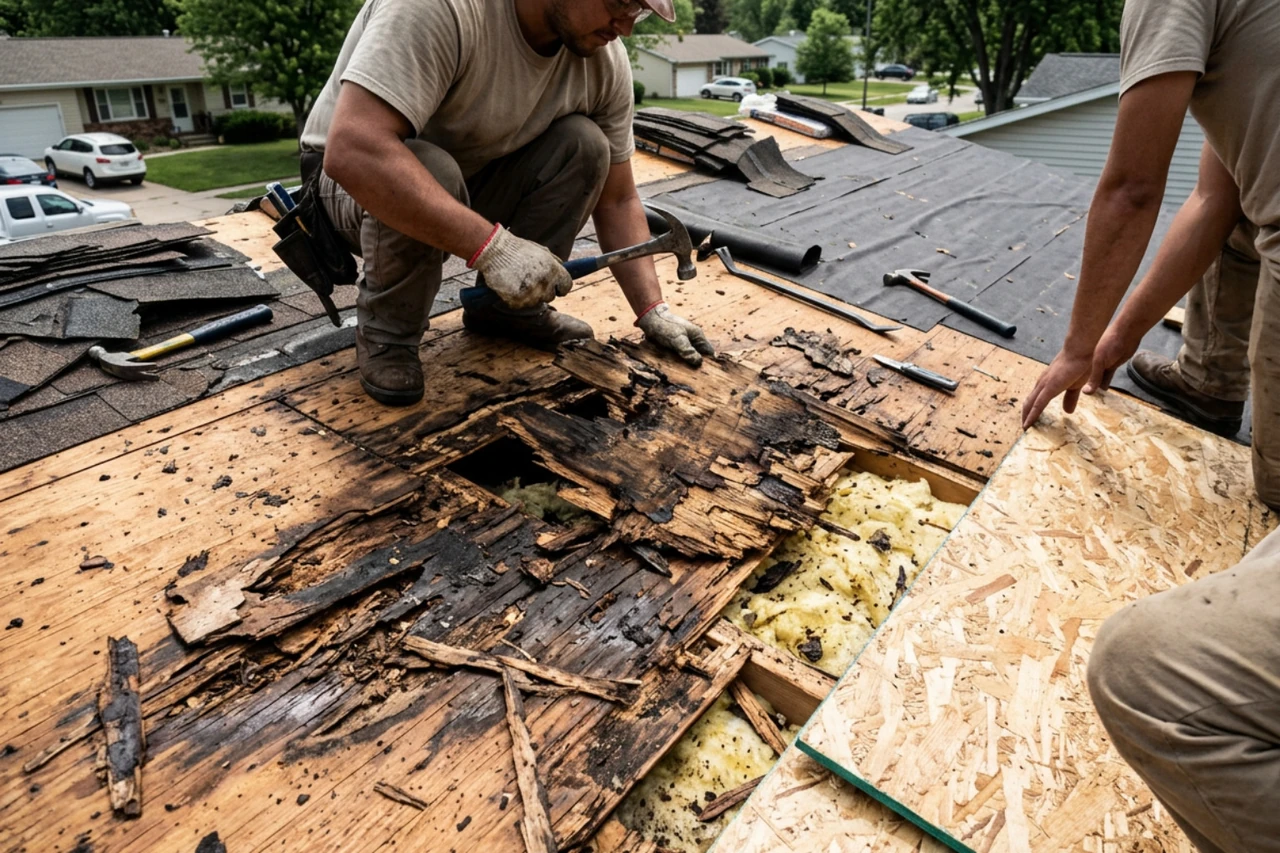
- Sagging Roofline or Spongy Decking: If you notice your roofline curving or sagging between rafters, or if walking on the roof feels bouncy and spongy, you have a serious structural issue. This usually means moisture has rotted the underlying plywood sheathing (decking), weakening its ability to hold nails and support heavy snow loads.
- Underlayment Failure: The underlayment is the water-resistant barrier installed directly on top of the wood decking. If this layer degrades due to age or heat buildup, water will find its way to the wood decking even if your shingles look fine from the ground. Fixing this requires a complete tear-off of the shingles to replace the barrier underneath.
- Poor Attic Ventilation: Without proper intake vents at the soffits and exhaust vents at the ridge, heat and moisture get trapped in your attic. In the summer, this bakes your shingles. In the winter, it causes warm air to rise to the top of your roof, melting the snow cover.
- Ice Damming: When melted snow runs down your roof and reaches the cold eaves, it refreezes, forming a thick ridge of ice known as an ice dam. This ice dam traps water behind it, which can back up under your shingles and leak directly into your walls.
To protect against our local freeze-thaw cycles, we install heavy-duty water and ice barriers in valleys, around chimneys, and along the eaves of all our roof installations. This extra layer of self-adhering protection is designed to help keep water out when ice dams form or during heavy spring thaws.
If you are dealing with recurring leaks, you can read more about identifying common roofing problems to see how structural issues are evaluated.
How Do Local Weather and Materials Affect Your Choice?
Our weather in the Northwoods is beautiful, but it is incredibly tough on roofs. Heavy snow loads, thick ice dams, spring thaws, and falling pine needles all test your roof's integrity. In communities like Eagle River, Rhinelander, Minocqua, St. Germain, and Three Lakes, a roof has to be built to handle these specific challenges.
When it comes to materials, we believe in using products designed for our climate:
- GAF Asphalt Shingles: For residential shingle roofs, we only install GAF products. We recommend GAF because of their advanced wind resistance and built-in algae protection, which are essential for homes nestled in our damp, wooded lakefront properties.
- Standing Seam Metal Roofing: If you are looking for a premium, long-term solution, standing seam metal is an excellent option. It features hidden fasteners that are protected from the elements, and its smooth surface allows heavy snow to slide off easily, reducing the risk of structural strain and ice dams. While metal is highly durable, it does require a larger initial investment and may not fit every homeowner's budget.
- Commercial Flat Roofing: Flat and low-slope roofs on commercial buildings require specialized materials like TPO, EPDM, or specialized coatings. These systems need regular maintenance and timely repairs to prevent standing water from seeping through seams.
To learn more about our local installation standards, you can read about our new roof installation Northwoods WI services or check out our regional roof repair Tomahawk WI guide 2026 for localized maintenance tips.
Why is a professional inspection safer and more reliable than DIY?
While a ground-level check is a great way to start, climbing onto a steep, high, or snow-covered roof carries serious safety risks.
A professional inspection is often the safest and most reliable option. General home inspectors are great for a broad overview of a house, but they often evaluate roofs from the ground or a ladder. A specialized roofing contractor will walk the entire roof, physically checking the shingles, assessing the flashings, evaluating the gutters, and inspecting your attic ventilation system.
At Eagle River Roofing, we focus on providing clear, honest assessments with no-pressure guidance. We provide detailed written quotes, maintain exceptionally tidy job sites, and back our work with GAF Master Elite craftsmanship. You can learn more about our local history and values by visiting our roofing company Eagle River WI page.
Frequently Asked Questions About Roof Repair and Replacement
Does homeowners insurance cover a roof repair or a full replacement?
In most cases, homeowners insurance is designed to cover sudden, accidental damage caused by covered perils. This includes events like severe windstorms, hail damage, or a falling tree limb.
Insurance carriers do not cover gradual wear and tear, aging, or damage resulting from a lack of regular maintenance.
When reviewing your policy, it is important to understand the difference between Actual Cash Value (ACV) and Replacement Cost Value (RCV):
- RCV policies typically cover the actual cost of replacing your damaged roof with a similar new one, minus your deductible.
- ACV policies factor in depreciation, meaning the payout is based on the current depreciated value of your old roof, which may leave you with higher out-of-pocket costs.
If your roof has suffered storm damage, we recommend filing a claim promptly. Most insurance companies have a 12-month window from the date of the storm event to file a claim, though this can vary depending on your specific policy and municipality rules.
Can you replace just one section or slope of a roof?
Yes, a partial or phased replacement is sometimes a practical option. If a windstorm damages shingles on only one side of your roof, and the rest of the roof is young and in good condition, we can replace just that single slope.
However, there are a few challenges to keep in mind:
- Color Matching: Shingles naturally fade over time due to sun exposure. Even if we use the exact same brand and color style, new shingles will look darker and more vibrant than the weathered ones on the adjacent slopes.
- Long-Term Costs: Setting up safety equipment, ordering materials, and pulling permits carries fixed costs. Doing a partial replacement now and replacing the rest of the roof a few years later is usually more expensive than doing the entire project at once.
How long does a typical roof repair or replacement take?
The timeline for your roofing project depends on the size and complexity of your home, as well as our local weather:
- Minor Repairs: Simple fixes like replacing a few wind-damaged shingles, sealing a pipe boot, or repairing a small section of flashing can typically be completed in a few hours to a couple of days.
- Full Residential Replacement: A standard asphalt shingle replacement can take 1 to 3 days of active on-site work, depending on the system. A standing seam metal roof installation is more detailed and can take 3 to 5 days, depending on the system.
Our team coordinates material deliveries and dumpster drop-offs carefully to minimize disruption to your daily routine, and we typically perform a thorough magnetic sweep of your yard to collect stray nails. Local permit rules vary by municipality, and we will confirm all scheduling details with you during your initial estimate.
Conclusion
Deciding whether to repair or replace your roof does not have to be a stressful process. By looking at the physical warning signs, considering the age of your system, and running the cost-per-year math, you can make a decision that protects both your home and your budget.
A localized leak on a healthy roof is usually just a quick repair. But if your roof is pushing 20 years old, has widespread shingle damage, or is showing signs of structural sagging, investing in a durable replacement is often the most cost-effective path forward.
If you are unsure of your roof's true condition, the most practical next step is to get an honest, professional assessment. At Eagle River Roofing, we are proud to serve our neighbors across the Northwoods with clear communication, tidy job sites, and reliable craftsmanship.
Whether you need a quick storm repair or want to explore our long-lasting GAF shingle and metal options, we are here to help. Feel free to use our online tools to get an instant estimate for your project, or explore our roofing services to learn more about how we protect Northwoods homes.
This article is for general informational purposes only and may not reflect the most current products, pricing, codes, availability, weather-related recommendations, or roofing requirements for your specific property. Every home and roof is different, especially in the Northwoods. Please contact Eagle River Roofing directly for the latest information and guidance for your project.

