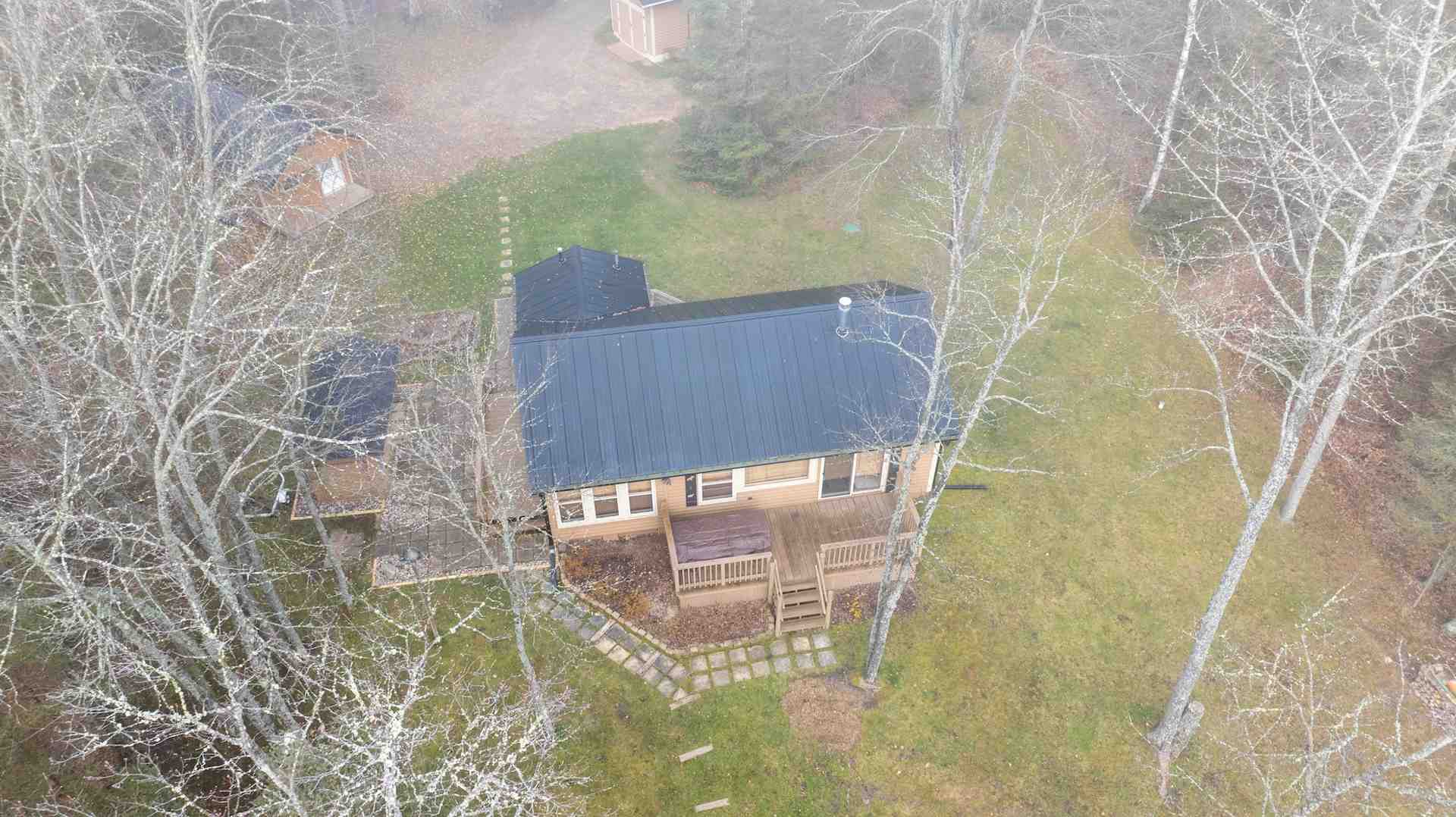
Why Northern Wisconsin Cabin Owners Can't Afford to Skip Gutters
Gutters for cabins in northern Wisconsin are not optional extras. They are one of the most important defenses your property has against the brutal Northwoods climate.
Quick answer: What gutters work best for northern Wisconsin cabins?
| Priority | Best Choice |
|---|---|
| Gutter size | 6-inch seamless (handles heavy snowmelt better than 5-inch) |
| Material | .032 aluminum or Galvalume for freeze-thaw durability |
| Gutter guard | Stainless micro-mesh (sheds pine needles and winter slush) |
| Snow protection | Heavy-duty hidden hangers + snow retention where needed |
| Key risk without gutters | Foundation erosion, fascia rot, basement leaks |
Northern Wisconsin winters are no joke. Some Northwoods areas see over 16 feet of snow in a single season. When that snow melts off your cabin roof, the water has to go somewhere. Without a properly installed gutter system, it goes straight down your foundation walls, into the soil around your cabin, and eventually into your basement or crawlspace.
It is not just snow either. The towering pines and oaks that make the Northwoods so beautiful drop constant debris into unprotected gutters. A clogged gutter gets heavy fast, pulling away from your fascia and letting water sneak behind the system and into your walls.
Cabin owners on the Small Cabin Forum have described 3 feet of snow sliding off metal roofs all at once, describing it as sounding like a freight train. Standard gutters simply are not built to survive that. The right system, installed the right way, is what separates a cabin that holds its value from one that quietly rots.
I'm Tyler Blair, owner of Eagle River Roofing, and our team has helped install millions of feet of gutters across the Northwoods. This includes cabins, lake homes, and year-round properties that face the exact conditions we cover in this guide on gutters for cabins in northern Wisconsin. Let's walk you through exactly what works up here, and why.
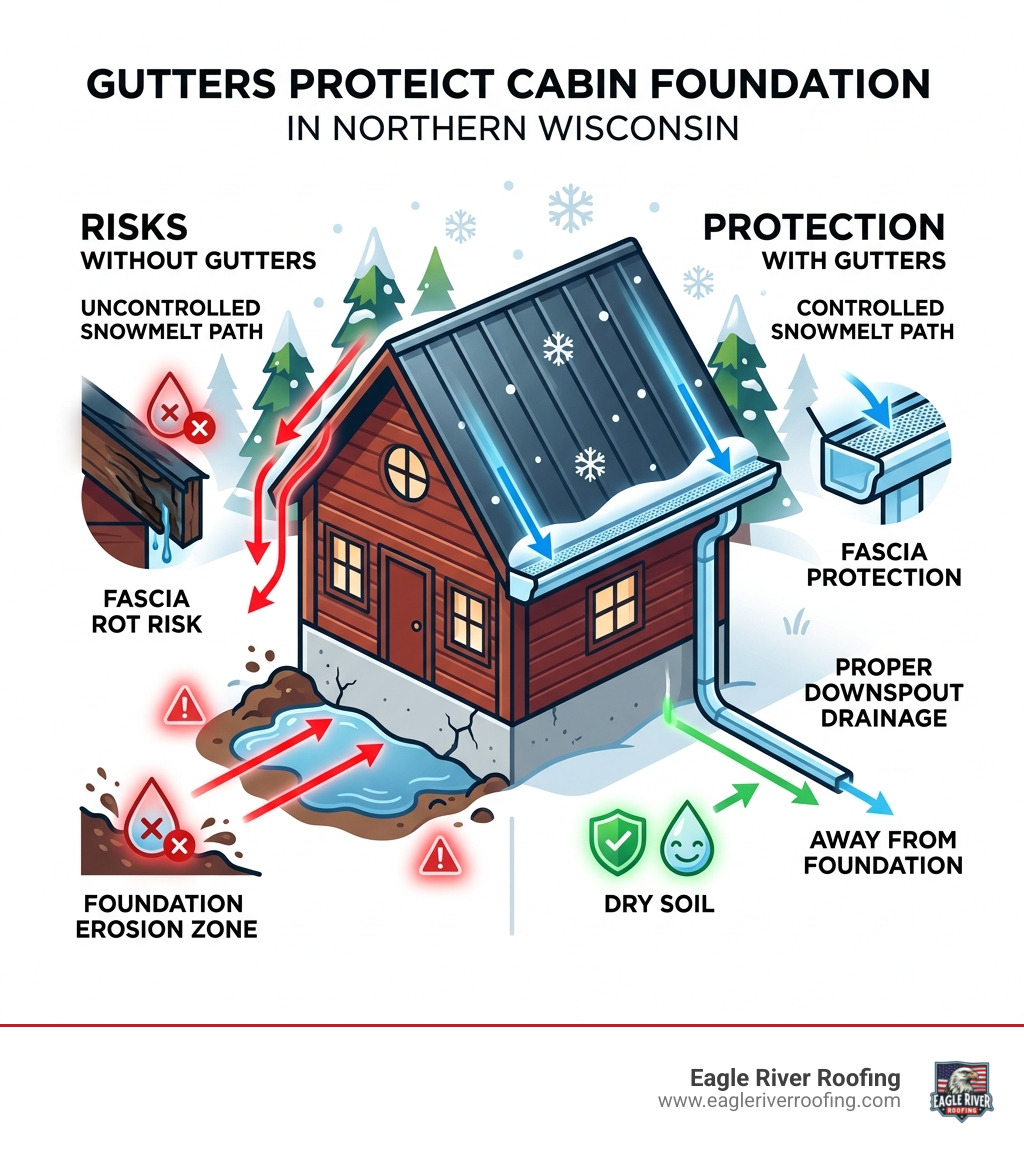
Gutters for cabins northern wisconsin terminology:
The Best Gutters for Cabins in Northern Wisconsin
When we talk about gutters for cabins in northern Wisconsin, we are not talking about the flimsy plastic sections you find at a big-box store. Those are fine for a shed in a mild climate, but they will shatter the first time a Northwoods ice storm hits. For a cabin in Eagle River, Minocqua, or Three Lakes, you need a system that is custom-built for the environment.
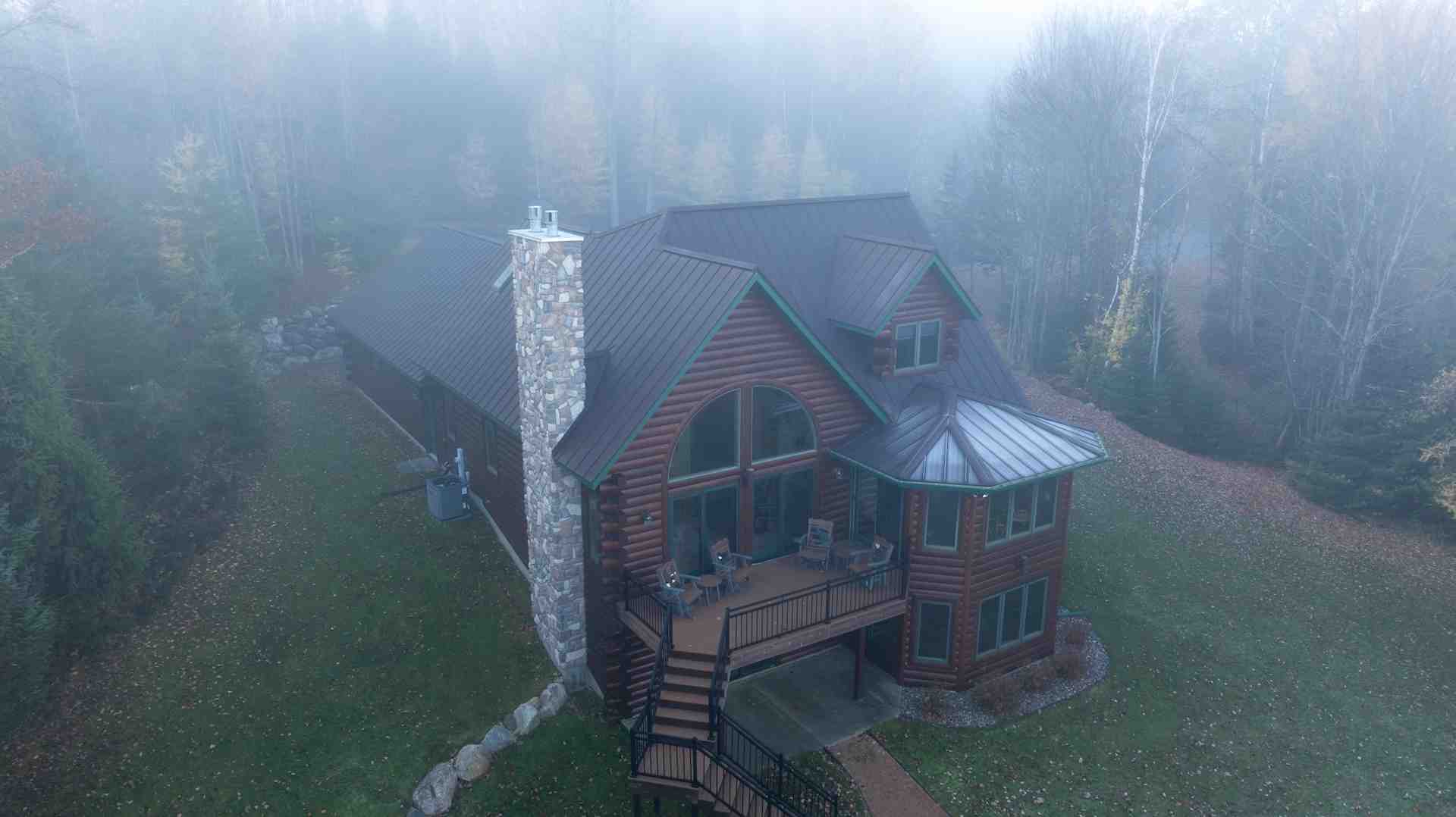
Seamless gutters are the gold standard for cabins. Because they are formed on-site from a single piece of metal, they do not have the seams that traditional gutters do. In our freeze-thaw cycles, seams are where ice expands and forces metal apart, leading to leaks. By eliminating those joints, we eliminate the primary failure point.
We recommend .032-inch thick aluminum for most cabin installations. This is the thickest aluminum available for residential use and provides the rigidity needed to hold up under a heavy snow load. While some homeowners consider copper for that classic Adirondack look, aluminum is the most common choice because it is durable, rust-proof, and comes in over 30 colors to match your cabin’s siding or trim.
Why Gutters for Cabins in Northern Wisconsin Prevent Foundation Damage
Many cabin owners think that because they have a wide roof overhang, they do not need gutters. Unfortunately, that is a myth that leads to expensive repairs. When rain or snowmelt pours off your roof, it hits the ground with significant force. This causes several problems:
- Soil Erosion: The constant "waterfall" effect digs a trench around your cabin. This can wash away the soil that supports your foundation or piers.
- Basement and Crawlspace Leaks: Once that water pools against the foundation, hydrostatic pressure forces it through tiny cracks in the concrete. This leads to mold, mildew, and damp Northwoods basements.
- Splash Back: When water hits the ground, it splashes mud and moisture back up onto your bottom logs or siding. Over time, this constant dampness causes rot and attracts wood-boring insects.
By installing a proper gutter system in Eagle River, you catch that water at the roofline and direct it safely away from the structure.
Choosing Durable Gutters for Cabins in Northern Wisconsin Metal Roofs
Metal roofs are incredibly popular for cabins because they shed snow so well. However, that "shedding" is exactly what destroys gutters. When a massive shelf of snow slides off a metal roof, it acts like a guillotine for any gutter in its path.
To survive this, we use specific installation techniques. First, we often mount the gutters slightly lower than the "fall line" of the roof. This allows the bulk of the sliding snow to shoot over the top of the gutter while still catching the water runoff. We also use heavy-duty hidden screw hangers instead of old-fashioned spikes. These hangers are spaced much closer together than in warmer climates (often every 12 to 18 inches) to provide maximum structural support.
If you are considering a cabin roof replacement, it is the perfect time to plan your gutter and snow retention strategy.
| Feature | 5-Inch Gutter | 6-Inch Gutter |
|---|---|---|
| Water Capacity | Standard | 40% More Capacity |
| Snow Load Support | Moderate | High |
| Best For | Small cabins, steep pitches | Large roofs, heavy Northwoods snow |
| Debris Handling | Clogs easier | Better flow for pine needles |
Surviving Northwoods Winters and Heavy Snow Loads
Winter in places like Ironwood, Hurley, and Manitowish Waters is a different beast entirely. We have seen winters where 16 feet of snow accumulates. That is a massive amount of weight. If your gutters are not "snow-ready," the weight of the ice and snow trapped inside them can literally tear the fascia board right off your cabin.
Ice dams are another major concern. When heat escapes from your cabin and melts the bottom layer of snow on your roof, that water runs down to the cold eaves and refreezes. This creates a dam that backs water up under your shingles. While we always recommend GAF shingles and proper attic insulation to prevent this, a heavy-duty gutter system is your last line of defense.
In some cases, we install self-regulating heat cables in the gutters and downspouts. These cables detect the temperature and turn on only when needed to create a clear path for meltwater to escape, preventing the "ice log" effect that breaks downspouts. This is especially important for safer entrances at Rhinelander offices and cabins alike.
Managing Ice Dams and Freeze-Thaw Cycles
The freeze-thaw cycle is what kills gutters. During the day, the sun melts snow; at night, it freezes solid. If your gutters are not pitched perfectly, that water sits and turns into a solid block of ice. This weight sags the gutters, ruins the pitch, and causes fascia rot.
We ensure every installation has a precise pitch toward the downspouts. We also check your fascia and soffit before we start. If we find existing rot, we fix it before the new gutters go up. You can learn more about these specialized systems through our residential seamless gutters guide.
Installation Techniques for Extreme Snow Loads
To make gutters for cabins in northern Wisconsin last for decades, we rely on three main techniques:
- Hidden Hangers: We use high-quality screw-in hangers that bite deep into the rafter tails, not just the fascia board.
- Increased Hanger Frequency: While the industry standard is one hanger every 24 or 36 inches, we space ours much closer to handle the weight of Northwoods slush.
- Oversized Downspouts: We prefer 3x4 inch downspouts over the standard 2x3. This allows slush and debris to pass through without backing up.
Protecting Your Cabin from Pine Needles and Debris
If you own a cabin in St. Germain, Boulder Junction, or Mercer, you know the struggle with white pines. Those long needles find their way into every nook and cranny. Clogged gutters are more than just a nuisance; they are a structural risk. When a gutter fills with needles and water, it can weigh several hundred pounds.
The Best Gutter Guards for Northwoods Foliage
Not all gutter guards are created equal. Many of the "foam" or "brush" inserts you see at hardware stores actually trap pine needles, making the problem worse. For the Northwoods, we recommend stainless steel micro-mesh systems like Alu-Rex or Leaf Solution.
These guards use the principle of surface tension to pull water into the gutter while the tiny holes are far too small for a pine needle or even a maple seed to enter. Wind then blows the dried debris off the top. This significantly reduces the time you spend on a ladder and ensures your gutter services are working year-round. If you want to learn more about how these systems work, the Wikipedia article on rain gutters gives a helpful overview of gutter design and water control.
Seasonal Maintenance Tips for Remote Cabins
If your cabin is a seasonal retreat, maintenance is even more critical. You are not there to see when a downspout gets blocked by a squirrel nest or a heavy spring rain.
- Spring Cleaning: Check for any sags caused by winter snow and clear out any leftover "winter grit" from your shingles.
- Fall Inspection: Ensure all downspout extensions are attached and directing water at least 5 to 10 feet away from the foundation.
- Check the Outlets: The most common place for a clog is the "elbow" where the gutter meets the downspout.
For those with larger properties, our commercial and residential installation guide offers more tips on managing large-scale drainage.
Frequently Asked Questions about Cabin Gutters
How much does professional gutter installation cost for a cabin?
The cost varies based on the size of your cabin, the number of corners, and the material chosen. For a typical Northwoods cabin, you can expect to pay between $1,500 and $3,500 for a high-quality seamless system with guards. While this is an investment, it is far cheaper than a $15,000 foundation repair or a $5,000 fascia replacement.
Do I need snow bars or snow stops with my gutters?
On metal roofs, the answer is almost always yes. Snow bars (long rails) or snow stops (individual cleats) hold the snow on the roof, allowing it to melt slowly rather than sliding off in one big avalanche. This protects your gutters, your landscaping, and anyone walking near the eaves.
Which gutter material is most durable for Northern Wisconsin weather?
For most cabins, .032 aluminum is the best balance of cost and durability. It does not rust, handles the cold without becoming brittle, and is strong enough for snow loads. If you want a more rugged, industrial look that can handle even more abuse, Galvalume (steel coated with aluminum and zinc) is an excellent, albeit heavier, option.
Conclusion
Your cabin is your sanctuary, but the Northwoods environment is constantly trying to reclaim it. From 16-foot snowfalls to the endless rain of pine needles, your roof and gutter system have a big job to do. At Eagle River Roofing, we live and work in these conditions every day. We know that a "standard" gutter job just won't cut it up here.
We serve the entire region, from Eagle River and Minocqua to Iron River and Ontonagon. We pride ourselves on tidy job sites, clear communication, and installations that are built to survive a Wisconsin winter. If you are ready to protect your cabin with professional gutters, give us a call or visit our website for a free, no-pressure estimate. We will help you design a system that keeps your foundation dry and your cabin beautiful for generations to come.
This article is for general informational purposes only and may not reflect the most current products, pricing, codes, availability, weather-related recommendations, or roofing requirements for your specific property. Every home and roof is different, especially in the Northwoods. Please contact Eagle River Roofing directly for the latest information and guidance for your project.

